Thursday, May 26, 2016

Monetary Valuation Methods for the Benefits of Cyclones

The final step in this study was linking the benefits of cyclones as ecosystem services to known monetary valuation methods. 
The benefits of cyclones and their corresponding ecosystem service types were linked to two sources containing valuation methods: 1) the conceptual matrix and example methods of ecosystem service valuation from Pascual & Muradian (2010), and 2) the near 1500 valuation methods from studies in The Economics of Ecosystems and Biodiversity (TEEB) database (Van der Ploeg & De Groot, 2010). In these sources, the valuation methods corresponding to cyclone benefits were categorized into five different approaches: cost based, stated preference, production based, revealed preference, and benefit transfer. All identified benefits were considered from the perspective of benefit to humans in order to be valued, including certain benefits from literature that were not directly classified as beneficial to humans. In these systems, these five valuation approaches are described as follows:

Cost based approaches depend on the estimation of the costs of recreating the service by artificial means.
Stated preference approaches apply surveys about a market with demand for services and hypothetical policy changes in the availability of these services. 
Production based approaches estimate how much services improve resources or environmental qualities, lead to lower costs and prices of marketed goods, and thus enhance income or productivity. 
Revealed preference approaches are based on observing individual choices in existing markets and services that are related to the services requiring valuation.
Benefit transfer approaches rely on the outcomes of a previous valuation from an area with a comparable ecosystem to the study area. If these two are comparable, the value can be transferred, or certain adjustments to reflect local circumstances can be applied. 
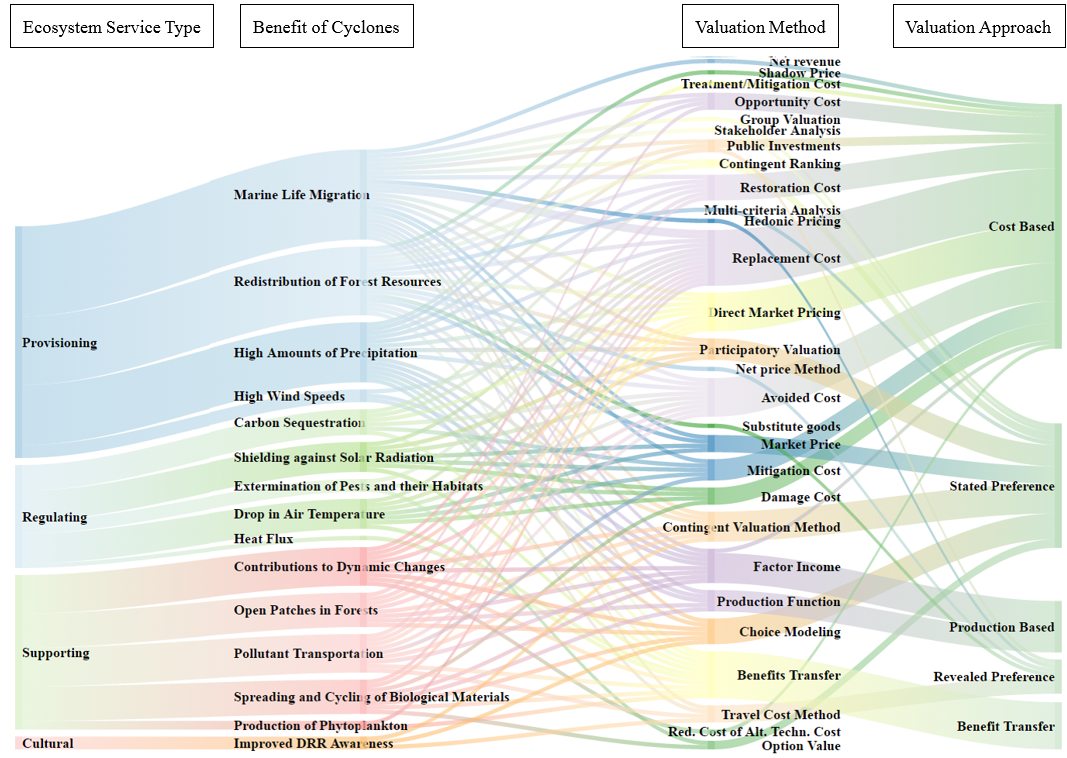

The final results (see figure) show that the applied valuation methods for comparable services were mostly related to the identified provisioning services, and most of the valuation methods used were cost based, namely replacement costs, direct market pricing, and avoided costs.

Monday, May 16, 2016

The Benefits of Cyclones as Ecosystem Services

After the first step of identifying the known benefits of cyclones, we linked identified benefits from both literature and case studies to ecosystem services categories developed by the UNEP (2009). The accompanying definitions and examples of provisioning, regulating, supporting, and cultural services are described as follows:

  • Provisioning services are products obtained from ecosystems. Examples include food, freshwater, wood, fiber, genetic resources, medicines, energy, and fisheries.
  • Regulating services help stabilize ecosystem processes and are benefits obtained from the regulation of ecosystem processes. Examples include climate regulation, natural hazard regulation, water regulation, water purification and waste treatment, and disease regulation.
  • Supporting services underlie the production of all other ecosystem services and related to fundamental environmental processes. Impacts can be direct or indirect, and can occur over a long time. Examples include biomass production, production of atmospheric oxygen, soil formation and retention, nutrient cycling, primary production, water cycling, and provisioning of habitat.
  • Cultural services are non-material benefits that people obtain from ecosystems, which could be recreational, spiritual, or religious variants. Examples include spiritual enrichment, intellectual development, reflection, religious experience, recreation, knowledge systems, social relations, aesthetic values, appreciation of nature, recreation, and ecotourism.

According to these definitions, we classified the benefits as in the image below:


Friday, May 6, 2016

The Benefits of Cyclones

It's been over a year since the World Water Forum in Korea, where one of the members of the typhoon committee argued the necessity of studying the benefits of cyclones, which I since then did. Preceding a presentation at the 7th International Conference on Water Resources and Environment Research  in Kyoto, June 5-9, I here provide an overview of the literary findings of benefits of cyclones.

Cyclones often cause heavy damages and destruction to infrastructure and human lives, but the potential benefits of cyclones remain understudied. Several of these benefits could serve as an integral part of ecosystem based disaster risk reduction plans, when viewed as ecosystem services. For this purpose, we examined how the benefits of cyclones could be valued as ecosystem services. In phase one of this study, we scrutinized existing studies regarding potential benefits of cyclones.


The image shows a compilation of the 14 benefits of cyclones as described in the gathered studies on the topic, which we organized by approximate location (troposphere, biosphere, epipelagic zone) and order (cause and effect) of occurrence. More details follow after the break below.

Friday, April 29, 2016

News in Japan - April

GEJET:
Court dismisses demand to halt Sendai reactors A Japanese high court has dismissed a request by residents to suspend operations of 2 nuclear reactors at the Sendai nuclear plant in southwestern Japan. The Miyazaki branch of the Fukuoka High Court gave its decision on Wednesday.

USA:
5 Dead in Houston as Flash Floods Leave Thousands Stranded and Without Power All five victims were found inside vehicles submerged in high floodwaters. “Houston residents should avoid travel at all costs today.”
Disaster plans often neglect historic preservation (USA) In Florida, for instance, they found that 23% of the sites listed on the National Register of Historic Places are located in a 100-year floodplain. Most communities have not integrated historic preservation into their disaster management plans. Their survey of state hazard mitigation plans found just 40 percent included a representative from historic preservation on the core planning team while 60 percent did not. "Many disaster mitigation plans make no mention of historic resources," Rumbach said. "As more and more communities bank on historic resources to benefit the local economy, this needs to be remedied." Economics aside, he said, many communities draw a sense of identity from these historic sites and can become unmoored when they are damaged or destroyed.

Netherlands:
Dutch public works department reinforces coastline at Zandvoort (Dutch) 2.4 million cubic meters of sand are being applied to the coast of Zandvoort and Bloemendaal. This previously happened in 2004 and 2008. The sand is deposited 750 meters from the beach at a depth of five meters. Wind, waves and currents then gradually spread the sand towards the beach. The work takes place over a length of 7.5 kilometers along the coastline, without disrupting beach visitors.
Snow in North of Netherlands and Randstad (Dutch) including fierce hail storms, leading to serious traffic accidents.

Tuesday, April 19, 2016

Earthquake in South Japan - part 3: Landslides

A first analysis of the landslides East of Kumamoto city have become available. The photos are courtesy of Kokusai Kogyo Co., Ltd. (国際航業株), taken on 16 April 2016; the maps are freely available from the Japanese GSI. These maps and photos show the earthquake damage points of concern (平成28年熊本地震災害で懸念される地震被害箇所), with a focus on river blocking by collapsed hill sides (河岸崩壊による河道閉塞箇所).

Affected area #1 lies between Kumamoto city and Mount Aso (阿蘇), just west of Kawayo (河陽), on Bungo highway (国道57号線).

You can also view the before/after photos in a google earth type environment here, courtesy of the GSI. More pictures, videos and maps here. See also the 3D model of area #1 and this drone video of area #1.

Monday, April 18, 2016

Earthquake in South Japan - part 2

A second heavy earthquake has struck Kyushu island early Saturday morning, leading to more deaths. Below is an analysis of the earthquakes from the first 84 hours following the initial Thursday evening earthquake, along with an overview of the effects, combined with strong wind damages, and the earthquake in Ecuador.

How to help: Kumamoto quake info: where to go, how to help

Shindou 1 2 3 4 5- 5+ 6- 6+ 7 Total
2≤M<3 0 1 18 0 0 0 0 0 0 19
3≤M<4 0 6 92 26 0 0 0 0 0 124
4≤M<5 0 0 14 41 2 0 0 0 0 57
5≤M<6 0 0 0 2 4 2 2 1 0 11
6≤M<7 0 0 0 0 0 0 2 1 1 4
7≤M<8 0 0 0 0 0 0 0 2 0 2
Total 0 7 124 69 6 2 4 4 1 217

For further analysis only earthquakes on Kyushu island were taken into account, and shindou (shaking intensity) 5- and 6- were counted as 5.0 and 6.0 whereas 5+ and 6+ were counted as 5.5 and 6.6 respectively. 

Friday, April 15, 2016

Earthquake in South Japan

9 people are reported dead and over 750 injured after a shindou 7 earrthquake has struck Kyushu island. The list of heavy aftershocks in the 12 hours since the initial earthquake is long. The Public Works Research Institute is conducting a conference, serving as a disaster response headquarters.

Japantoday: The nine dead are three men and four women aged between 54-94 in Mashiki, and a 29-year-old man and 68-year-old woman in the Higashi Ward of Kumamoto City. As of 5 a.m., at least 765 people were being treated for injuries, of which 53 were serious, while about 44,400 people were taking shelter at about 500 sites in the prefecture, according to the prefectural government. The strong quake resulted in collapsed houses and fires in the prefecture, according to local authorities. No abnormalities have been found at the Sendai nuclear power plant in Kagoshima Prefecture or the Genkai nuclear power plant in nearby Saga Prefecture, according to operator Kyushu Electric Power Co and the Nuclear Regulation Authority.

BBC: About 16,000 homes were left without electricity and 38,000 without gas, reports say.