Showing posts with label Earthquake. Show all posts
Showing posts with label Earthquake. Show all posts
Tuesday, January 17, 2017

Wednesday, November 30, 2016
News in Japan - November
USA:
Mississippi River could leave farmland stranded
Mississippi River could leave farmland stranded
If the Mississippi River continues to go unchecked, the farmland on Dogtooth Bend peninsula may be only accessible by boat. According to a University of Illinois study, each successive flood carves a deeper channel across the narrow neck of the peninsula. This floodwater shortcut threatens to permanently reroute the Mississippi River, leaving Dogtooth Bend an island rather than a peninsula. Repeatedly repairing the levee breaches, building a bridge over the shortcut created by the flooding, or letting the Mississippi chart its own course are some solutions to the problem.
Netherlands:
New Dutch drama, ‘if the levees breach’: http://www.npo.nl/series/artikelen/als-de-dijken-breken
Website visualizing floods in the Netherlands: http://www.overstroomik.nl/
Cadzand-Beach most closely resembles
Omaha Beach (Dutch) For the
first time enormous Xblocs, an innovation of construction consortium BAM, are
applied in the Netherlands. They must protect the hinterland from so-called
super storms that may arise from a combination of sea level rise and climate
change. The probability of such a super storm is 1 percent in a hundred years.
That seems low, but without proper protection the flood damages can amount to
more than one hundred billion euro. The three-dimensional shapes can be linked
to each other similar to Lego-blocks, so that the connection of the resulting dam
becomes extra strong. But by the openness persisting between the Xblocs, the
barrier absorbs the enormous power of the super waves instead of being averted.
The slender palisades also reduces the required material. A ‘small’ Xbloc
consists of 1.5 cubic meters of concrete, a large one of 4 cubic meters. That
is only one-third of the material which would be required for massive concrete
blocks of the same size. "The gaps between the Xblocs creates space for
all kinds of marine life. Small micro-organisms can settle here, but also fish
and crabs find shelter. We considered mixing the concrete with shell grit, so
that a large surface would be created with better adherence, but that was really
too expensive." Research at Rijkswaterstaat in 2003 showed that the force
with which the waves hit the shore is greater than previously thought. At nine
locations along the Dutch coast dunes or dikes had to be reinforced to be able
to withstand a superstorm. When Minister Schultz van Haegen (Infrastructure and
Environment) formally closed the work in Cadzand today, all the weak links will
have been restored.
Tuesday, November 22, 2016
Minor earthquake and tsunami
This morning we were awoken by an earthquake of magnitude 7.3, shindou 5- off the coast of Fukushima with some small aftershocks. Our phones immediately gave off tsunami warnings (1-3 meter). Several coastal towns have received evacuation warnings.

This map shows the locations and heights of tsunami waves in cm measured according to the JMA:

Wednesday, October 12, 2016
Pressure and Release (PAR) model, part 1
Along with now graduated Dr. Nasif Ahsan, I was invited to give a lecture to our new M.Sc. students as part of the course "Basic Concepts of Integrated Flood Risk management (IFRM)". This part of the course centers around the Pressure and Release (PAR) model, as developed by Ben Wisner, Piers Blaikie, Terry Cannon, and Ian Davis in their publication "At Risk: natural hazards, people’s vulnerability and disasters" (Routledge, London & NY, 2004).

The concept behind the PAR model is that disasters occurs when societal vulnerability coincides with (natural) hazards.The only way to reduce risk is reduction of vulnerability, rather than the hazard itself. This concept is explained in the images below.


For the lecture we each focused on how the PAR model could be applied to our home countries, Bangladesh and the Netherlands. I added an interactive component in which the students developed their own version of the PAR model for floods in the Netherlands.

Friday, September 30, 2016
News in Japan - September
Japan
It seemed to miss
Japan altogether before coming back with a vengeance:
USA
Other
How
plant roots sense, react to soil flooding Researchers
have just discovered a mechanism that allows a plant to adjust its water status
and growth according to different soil flooding conditions. The results of this
study describe how roots sense and respond to soil oxygen and potassium levels
jointly, so as to change their water uptake capacity. Aside from their
scientific importance, these findings could make it possible to optimize crop
flood tolerance.
http://aqua-monitor.appspot.com/
Vulnerable people
Floods
severely affect children, young people Research
with flood-affected children reveals serious impacts on well-being but also a
desire to take on a role in flood risk management. Factors impacting on
children's well-being include: loss of valued personal and family possessions,
friendship networks, familiar spaces, education; experience of fear, anxiety,
poverty, isolation, unfairness, destruction, stress, uncertainty, being
ignored/misunderstood; lack of sleep and recreation; deterioration in diet,
space and housing conditions; lack of flood education provision in schools for
children and all staff. The study shows that having an active role in flood
risk management actually helps with children's recovery. Yet current flood and
emergency planning policy either ignores children or positions them as
'vulnerable', rather than treating them as citizens in their own right. The
report proposes children should be given more information before, during and
after flooding because they have a right to know how to prepare, what to expect
and how they can contribute.
Friday, May 27, 2016
News in Japan - May
Japan:
80% of SDF big choppers couldn’t fly for Kumamoto mainly because they were undergoing emergency checks
Gov't to call for beefing up support for foreign visitors in disaster (Japan) Tourism organizations should get the picture of the locations of evacuation centers as well as hospitals that can accept foreigners, according to the planned request. The guidelines state examples of foreign language terms regarding evacuation and advice, and urge making use of volunteer interpreters and preparation of emergency meals that can be provided to Muslims.
Friday, April 29, 2016
News in Japan - April
GEJET:
Court dismisses demand to halt Sendai reactors A Japanese high court has dismissed a request by residents to suspend operations of 2 nuclear reactors at the Sendai nuclear plant in southwestern Japan. The Miyazaki branch of the Fukuoka High Court gave its decision on Wednesday.
USA:
5 Dead in Houston as Flash Floods Leave Thousands Stranded and Without Power All five victims were found inside vehicles submerged in high floodwaters. “Houston residents should avoid travel at all costs today.”
Disaster plans often neglect historic preservation (USA) In Florida, for instance, they found that 23% of the sites listed on the National Register of Historic Places are located in a 100-year floodplain. Most communities have not integrated historic preservation into their disaster management plans. Their survey of state hazard mitigation plans found just 40 percent included a representative from historic preservation on the core planning team while 60 percent did not. "Many disaster mitigation plans make no mention of historic resources," Rumbach said. "As more and more communities bank on historic resources to benefit the local economy, this needs to be remedied." Economics aside, he said, many communities draw a sense of identity from these historic sites and can become unmoored when they are damaged or destroyed.
Netherlands:
Dutch public works department reinforces coastline at Zandvoort (Dutch) 2.4 million cubic meters of sand are being applied to the coast of Zandvoort and Bloemendaal. This previously happened in 2004 and 2008. The sand is deposited 750 meters from the beach at a depth of five meters. Wind, waves and currents then gradually spread the sand towards the beach. The work takes place over a length of 7.5 kilometers along the coastline, without disrupting beach visitors.
Snow in North of Netherlands and Randstad (Dutch) including fierce hail storms, leading to serious traffic accidents.
Tuesday, April 19, 2016
Earthquake in South Japan - part 3: Landslides
A first analysis of
the landslides East of Kumamoto city have become available. The photos are
courtesy of Kokusai Kogyo Co., Ltd. (国際航業株), taken on 16 April 2016;
the maps are freely available from the Japanese GSI. These
maps and photos show the earthquake damage points of concern (平成28年熊本地震災害で懸念される地震被害箇所), with a focus on river blocking by collapsed hill sides (河岸崩壊による河道閉塞箇所).

You can also view the before/after photos in a google earth type environment here, courtesy of the GSI. More pictures, videos and maps here. See also the 3D model of area #1 and this drone video of area #1.
Monday, April 18, 2016
Earthquake in South Japan - part 2
A second heavy earthquake has struck Kyushu island early Saturday morning, leading to more deaths. Below is an analysis of the earthquakes from the first 84 hours following the initial Thursday evening earthquake, along with an overview of the effects, combined with strong wind damages, and the earthquake in Ecuador.
How to help: Kumamoto quake info: where to go, how to help
| Shindou | 1 | 2 | 3 | 4 | 5- | 5+ | 6- | 6+ | 7 | Total |
| 2≤M<3 | 0 | 1 | 18 | 0 | 0 | 0 | 0 | 0 | 0 | 19 |
| 3≤M<4 | 0 | 6 | 92 | 26 | 0 | 0 | 0 | 0 | 0 | 124 |
| 4≤M<5 | 0 | 0 | 14 | 41 | 2 | 0 | 0 | 0 | 0 | 57 |
| 5≤M<6 | 0 | 0 | 0 | 2 | 4 | 2 | 2 | 1 | 0 | 11 |
| 6≤M<7 | 0 | 0 | 0 | 0 | 0 | 0 | 2 | 1 | 1 | 4 |
| 7≤M<8 | 0 | 0 | 0 | 0 | 0 | 0 | 0 | 2 | 0 | 2 |
| Total | 0 | 7 | 124 | 69 | 6 | 2 | 4 | 4 | 1 | 217 |
For further analysis only earthquakes on Kyushu island were taken into account, and shindou (shaking intensity) 5- and 6- were counted as 5.0 and 6.0 whereas 5+ and 6+ were counted as 5.5 and 6.6 respectively.

Friday, April 15, 2016
Earthquake in South Japan
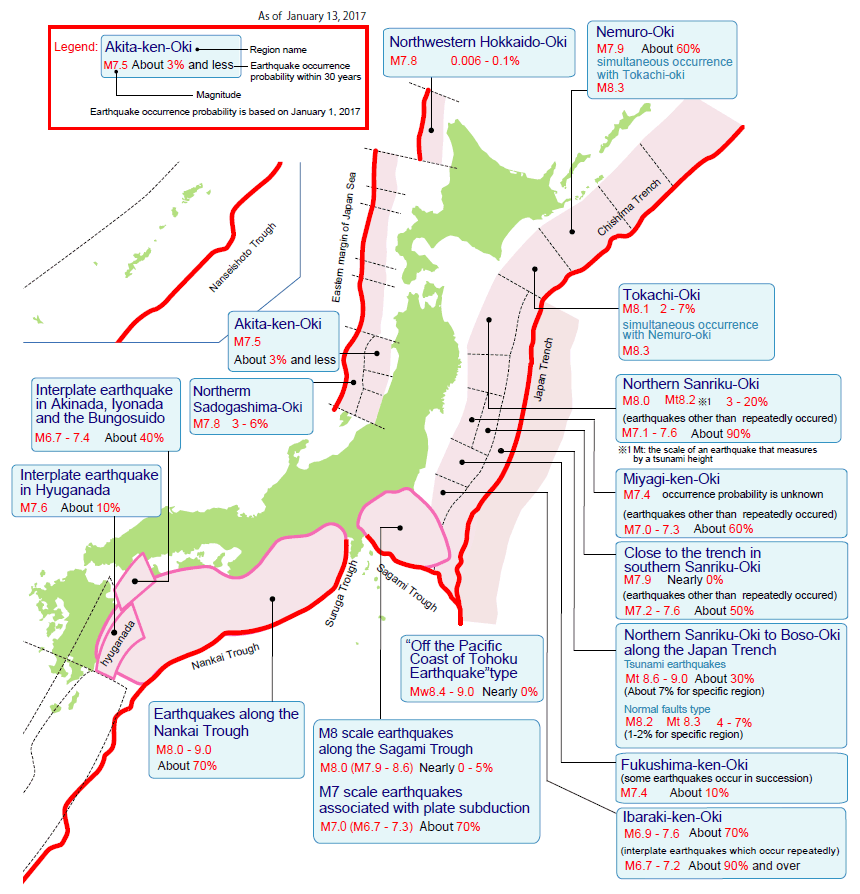
9 people are reported dead and over 750 injured after a shindou 7 earrthquake has struck Kyushu island. The list of heavy aftershocks in the 12 hours since the initial earthquake is long. The Public Works Research Institute is conducting a conference, serving as a disaster response headquarters.
Japantoday: The nine dead are three men and four women aged between 54-94 in Mashiki, and a 29-year-old man and 68-year-old woman in the Higashi Ward of Kumamoto City. As of 5 a.m., at least 765 people were being treated for injuries, of which 53 were serious, while about 44,400 people were taking shelter at about 500 sites in the prefecture, according to the prefectural government. The strong quake resulted in collapsed houses and fires in the prefecture, according to local authorities. No abnormalities have been found at the Sendai nuclear power plant in Kagoshima Prefecture or the Genkai nuclear power plant in nearby Saga Prefecture, according to operator Kyushu Electric Power Co and the Nuclear Regulation Authority.

Wednesday, March 30, 2016
News in Japan - March
GEJET:
Japan marks 5 years since the 3/11 disaster The Reconstruction Agency says at least 3,407 people died in 10 prefectures due to health problems and other reasons related to their lives as evacuees. The agency adds that as of February 12th, more than 174,000 people were living in temporary, rental or other housing as evacuees.
The Fukushima cleanup will take generations The cleanup team is still struggling to halt the buildup of contaminated water, and the techniques and equipment needed to locate, extract, and dispose of the melted fuel have yet to be developed. Given these challenges, many experts are convinced that the decommissioning process will take far longer than the official 40-year timetable-perhaps as long as a century. Rainwater and groundwater have continued to pour into the damaged basements of Units 1-4, where it mixes with the highly radioactive cooling water already inside the buildings. The pillars of TEPCO's water management efforts to date are two systems for channeling groundwater away from the contaminated basements and releasing it into the ocean relatively free of radioactive contaminants. One, the groundwater bypass system, collects water in wells dug between the reactor buildings and the hills to the west. The water is pumped up from the wells, tested, and eventually released into the ocean. The other, called the subdrain system, uses wells dug around the perimeter of the reactor buildings. So far, TEPCO has discharged some 230,000 tons of water into the ocean using these two methods combined. Even so, groundwater continues to pour into the buildings' basements at the rate of about 150 tons a day.
Lessons from Fukushima An RJIF study of hospital responses to the disaster found medical care for the afflicted was only able to continue at significantly reduced capacity because kizuna — social solidarity built upon people-to-people bonds, social networks and personal contacts — swung into action to mobilise armies of volunteers in forming the core engine of recovery. It was the residents of Fukushima who heroically banded together to manage the crisis. ‘[I]t is an unfortunate reality that in 2011 Japan had to resort to kizuna, even during the initial phase of crisis management, due to inadequate centralised management…Japan must now look beyond kizuna and build a crisis response apparatus that doesn’t overly rely on the goodwill of the Japanese people’. The people of Japan deserve better than having to rely on kizuna next time round. ‘To date, the NRA has received safety review applications for a total of 25 of the 43 existing commercial reactors’, Koppenborg reports. Commercial interests now have to face up to the NRA’s new regulatory teeth. It appears unlikely that further applications will be made and not all of these 25 applications can count on being successful. But ‘if Japan is to meet its goal of generating 20–22 per cent of its power through nuclear energy by 2030 it needs to reopen 30 reactors’, says Koppenborg. Richard Samuels argues that ‘perhaps the most striking development in the weeks and months after the devastation was how champions of existing institutions, practices, preferences and ideas — even those that failed so spectacularly and so indisputably — rallied to define the lessons that would be drawn. Political entrepreneurs from every corner framed the catastrophe to justify, legitimate, fortify and sell their pre-existing preferences. Japanese politics became a competition for control of who would define the heroes and the villains of the tragedy — and for the power to determine what would come next. Five years on, the 3.11 master narrative is still under construction’. This mindset is a key obstacle in the political gridlock that blocks improved disaster preparedness and strengthening Japan’s crisis management system as well as a more wholehearted approach to renewable energy sources.
Japan’s 3.11 master narrative still under construction In short, few agreed on policy alternatives, but everyone insisted that 3.11 proved they had been right all along. So where are we five years later? Were civic activists who argued that systemic dysfunctions in Japan can now be fixed correct? Or was one parliamentarian right when he suggested that 3.11, as colossal as it was, may not have been big enough to stimulate substantive institutional change? The evidence is mixed. The popularity of the Abe administration notwithstanding, opinion polls in the years after 3.11 suggest that the public is disillusioned with government. In 2013 large majorities reported that they believed reconstruction funds were wasted. Trust in government increased for a time, but recent data show that it has fallen and is below the global average.
Japan:
LDP to tackle 'taboo' of expanding foreign labor force Japan's ruling party kicks off a debate this month on whether to expand the pool of foreign workers to cope with a graying, shrinking population, challenging a longstanding "taboo" on immigration. But rather than rely on immigration, Prime Minister Shinzo Abe wants to focus on drawing more women and elderly into the workforce to fill the gaps, and has made raising Japan's rock-bottom birthrate a priority. The only way to ensure growth was to increase the size of the workforce, Kimura said in an interview, adding that monetary and fiscal policies were reaching the limit of their capacity to spur growth.
USA:
Single By Choice: Why Fewer American Women Are Married Than Ever Before When I say "the choice to not marry," that doesn't always translate into "I am a woman and I am deciding that I am not going to get married," or "I am rejecting marriage." The choice to not marry can also mean: "I would really like to marry or to fall in love or to meet someone, but I haven't met someone who I feel is going to improve on the life that I am building and making on my own." One of the most startling statistics is that today only 20 percent of Americans aged 18 to 29 are married, and that compares to 60 percent in 1960. The other figure that I find very startling, in part because it was so resilient for so long, is the median age of first marriage for women. From the time they started recording it — which was 1890 — until 1980, that median age of first marriage for women fluctuated only between 20 and 22. In 1990 it jumped to over 23, which is a huge jump from having been in that small range for so long. Today, for women, it is over 27. So if you're just looking at the sort of historical picture, there's this relatively flat line for almost 100 years and now there's not just a jump over that line, but way over that line.
Research will help policymakers plan for sea level rise (USA) A new study could help protect more than 13 million American homes that will be threatened by rising sea levels by the end of the century. It is the first major study to assess the risk from rising seas using year 2100 population forecasts for all 319 coastal counties in the continental US. Previous impact assessments use current population figures to assess long-term effects of coastal flooding.
Wetland enhancement in Midwest could help reduce catastrophic floods of the future (USA) New financial models and flood management policies may be needed to actually accomplish this. If just 1.5 percent of the land were used for wetlands, the peak flow of the overall watershed could be reduced by up to 17.5 percent.
Netherlands:
Other:
When sea levels rise, damage costs rise even faster A team of scientists from the Potsdam Institute for Climate Impact Research (PIK) now provides a method to quantify monetary losses from coastal floods under sea-level rise. For the first time, the scientists show that the damage costs consistently increase at a higher rate than the sea-level rise itself.
Citizen science to prevent the effects of floods (Spain) Researchers from UPM are involved in the development of a mobile phone application that allows user to share information about floods and their effects aiming to help researchers.
The best way to protect us from climate change? Save our ecosystems There is now clear evidence that intact forests have a positive influence on both planetary climate and local weather regimes. Forests also provide shelter from extreme weather events, and are home to a host of other valuable ecosystems that are important to human populations as sources of food, medicine and timber. In Vietnam, 12,000 hectares of mangroves have been planted at a cost of US$1.1 million, but saving the US$7.3 million per year that would have been spent on maintaining dykes. In Louisiana, the destruction of Hurricane Katrina in 2005 led to an examination of how coastal salt marshes might have reduced some of the wave energy in the hurricane-associated storm surges. Data have now confirmed that salt marshes would have significantly reduced the impact of those surges, and stabilised the shoreline against further insult, at far less cost than engineered coastal defences. With this data in hand, discussions are now beginning around how to restore the Louisiana salt marshes to insulate against future extreme weather events.
Climate change is a potent element in the deadly brew of disaster risk Are we getting better at managing disasters, or are we actually reducing disaster risk? There is a significant difference between the two, and addressing that difference should have a profound impact on development. at least 90% of disasters linked to natural hazards are climate related. Mortality is declining in many places because of better disaster management andmore effective use of early warning systems. But more needs to be done to reduce risk comprehensively, including by tackling the compounding factors of poverty and inequality, rapid and unplanned urbanisation, damage to eco-systems, and poor risk governance. More national disaster loss databases to guide investments should be established.
Paris prepares for possible deluge similar to 1910 Great Flood More than 100 years ago, the Seine River rose 8m above its usual level following months of high rainfall, causing the catastrophe known as the Great Flood of Paris. There were no deaths but it took around 35 days for the water to clear.
Each year there is a one in 100 chance that a flood of that scale will occur in Paris again. The exercise will be carried out as if the river levels are rising by 50cm each day, allowing 900 emergency personnel, 150 police officers and 40 emergency vehicles to practice the necessary steps they will have to take. The exercise will also test how almost 90 public and private institutions such as hospitals, energy firms and waste disposal companies cope with the situation. “The difference between 1910 [and now] is that at that time we didn’t have telephone lines, the subway or electrics running underground. Now... if you have water [underground], everything will [go] down". The flood could cover an area measuring 500sq/km and affect the 830,000 people who live in the zone. More than 430,000 homes would be exposed to water as well as 100,000 businesses. Rectifying the damage could cost the city up to £15.5 billion.
Speeding up accuracy of flood risk assessment (Australia) The new method tested by the research team is aimed at providing a highly accurate assessment at a much faster rate. The method (known as hybrid causative events, or HCE) relies on an algorithm that knocks out all of the unnecessary information used by the slower, continuous simulation approach -- such as long, dry periods without rainfall. It might take another five years or so for this method to be available to industry.
Adaptation to increasing flood risk in Europe should aim to reduce impact Scientists investigated the benefits of four adaptation measures to reduce the increasing flood risk in Europe under state-of-the-art global warming projections under a high-end climate scenario. Adaptation measures include the rise of flood protections, reduction of the peak flows through water retention, reduction of vulnerability and relocation to safer areas. According to the study, adaptation efforts should favour measures targeted at reducing the impacts of floods, such as relocation and vulnerability reduction, rather than trying to avoid them. Reducing vulnerability includes early warning systems, dry and wet flood proofing, and floating buildings, among others. Conversely, adaptation plans only based on rising flood protections have the effect of reducing the frequency of small floods and exposing the society to less-frequent but catastrophic floods and potentially long recovery processes.
Can improved agricultural practices help combat climate change? Did you know that over half of global non-carbon dioxide (non-CO2) greenhouse gas (GHG) emissions are accountable to agriculture?
'Unprecedented' storms and floods are more common than we think (UK) They conclude that 21st-century flood events such as Storm Desmond are not exceptional or unprecedented in terms of their frequency or magnitude, and that flood frequency and flood risk forecasts would be improved by including data from flood deposits dating back hundreds of years. "Conventional methods of analysing river flow gauge records cannot answer these questions because upland catchments usually have no or very short records of water levels of around 30 or 40 years. In fact, recent careful scientific analysis of palaeoflood deposits (flood deposits dating back hundreds of years) in the UK uplands shows that 21st-century floods are not unprecedented in terms of both their frequency (they were more frequent before 1960) and magnitude (the biggest events occurred during the 17th–19th centuries)." Professor John Lewin from the University of Aberystwyth said: "What is needed, is far more resilience for already-developed floodplains, and much more serious insistence that future floodplain development should be virtually curtailed. Somewhere along the line floodplain development has been allowed by local authorities and the UK government to continue regardless."
Vulnerable people:
One-third of working women in Japan sexually harassed: study The study, released Tuesday and the first of its kind, examined responses from more than 9,600 women employees, submitted by mail or online. The response rate was 18%. Of the respondents, 29% said they had suffered sexual harassment. The most common type of harassment was having their appearance or age become the focus of conversation, at 54%. The next most common was unwanted touching at 40%, followed by sexually related questions at 38%. Twenty-seven percent were asked out for meals and dates.
Few women in higher management Netherlands (Dutch) Results from the report http://www.grantthornton.global/globalassets/wib_turning_promise_into_practice.pdf show that only 18% of positions in higher management are held by women in the Netherlands. Japan scores lowest of researched countries with 7%, and Russia highest with 45%.
Japan rejects U.N. panel view on 'comfort women' Japan rejected on Tuesday a U.N. panel's view that Tokyo should take into consideration the opinions of so-called comfort women in implementing a bilateral agreement reached with South Korea last year. "The (panel's) conclusion does not sufficiently reflect the Japanese government's explanation and is regrettable," Foreign Minister Fumio Kishida told reporters. The U.N. Committee on the Elimination of Discrimination against Women said Monday the agreement did not fully adopt a victim-centered approach to address the issue of women who were procured for Japan's wartime military brothels.
1 in 29 babies born in Japan in 2014 had non-Japanese parent The number of babies whose parents are both non-Japanese totaled about 15,000, compared with 20,000 who were born to Japanese and non-Japanese couples, according to the ministry data.
How People Learn to Become Resilient If you are lucky enough to never experience any sort of adversity, we won’t know how resilient you are. It’s only when you’re faced with obstacles, stress, and other environmental threats that resilience, or the lack of it, emerges: Do you succumb or do you surmount? Not all of the at-risk children reacted to stress in the same way. Two-thirds of them “developed serious learning or behavior problems by the age of ten, or had delinquency records, mental health problems, or teen-age pregnancies by the age of eighteen.” But the remaining third developed into “competent, confident, and caring young adults.” They had attained academic, domestic, and social success—and they were always ready to capitalize on new opportunities that arose. A resilient child might have a strong bond with a supportive caregiver, parent, teacher, or other mentor-like figure. But another, quite large set of elements was psychological, and had to do with how the children responded to the environment. The resilient children had what psychologists call an “internal locus of control”: they believed that they, and not their circumstances, affected their achievements. The resilient children saw themselves as the orchestrators of their own fates. In fact, on a scale that measured locus of control, they scored more than two standard deviations away from the standardization group. One of the central elements of resilience, Bonanno has found, is perception: Do you conceptualize an event as traumatic, or as an opportunity to learn and grow? “Events are not traumatic until we experience them as traumatic.” Werner found that resilient individuals were far more likely to report having sources of spiritual and religious support than those who weren’t. You can train people to better regulate their emotions, and the training seems to have lasting effects. Unfortunately, the opposite may also be true. “We can become less resilient, or less likely to be resilient,” Bonanno says. “We can create or exaggerate stressors very easily in our own minds. That’s the danger of the human condition.”
First gender identity disorder doctors certified in Japan The society eventually hopes to make the cost of hormone therapy and gender reassignment surgery, which is currently fully shouldered by the patients, covered by national health insurance.
Friday, January 29, 2016
News in Japan - January
Mississippi River inundates southern Illinois; Memphis is next: The deadly onslaught of rising waters and storms has killed more than two dozen people in Missouri and Illinois. "I'm from this part of the state and, quite frankly, it's almost hard to believe," the Missouri governor said. "It's almost as if you're living on some other planet."
Blizzard is over on East Coast, but Monday travel could be daunting (USA)
Blizzard is over on East Coast, but Monday travel could be daunting (USA)
When the Big One comes: the woman preparing LA for life after a major quake
LA isn’t just idly waiting for the catastrophe. For the past year, Mayor Eric Garcetti has been working with the US Geological Survey’s southern California earthquake expert Dr Lucy Jones to develop an quake resiliency strategy for the city. In October, the city enacted the showpiece of that effort, a set of aggressive seismic regulations that will require retrofits on more than 15,000 buildings across the city.
The city of Los Angeles is complex, with strong neighbourhood identities, a fabled history, growing cultural assets, people from more than 150 countries speaking 220 languages, and industries – old and new – that are reinventing, innovating and constantly changing.
The city of Los Angeles has 87 other cities in the county and Southern California is much larger. So in order for the city to be resilient, working with our neighbours and the rest of Southern California to improve our resilience is really important.
In December 2014, the mayor’s office released Resilience By Design, an 18-point plan to help the city prepare for, respond to and recover from earthquakes. Its recommendations led to the city’s seismic retrofit ordinance, and also seek to address water security and telecommunications stability in the event of a large earthquake. Aho is working to improve the stability of cell phone towers so that they’ll be able to operate and connect people with critical emergency services during an earthquake or other major disaster.
The main tunnels that bring water from the California Aqueduct down to the Los Angeles basin lay almost directly on top of the San Andreas Fault, a major continental fault between the Pacific and North American plates. A moderate to major earthquake could destroy the tunnels and cut off the city from its water supply.
The key is getting ready, Aho says. “Typically you have a major disaster, a Northridge, a Katrina, a Sandy, and then you start making changes,” she says. “We’re making changes before.”
LA isn’t just idly waiting for the catastrophe. For the past year, Mayor Eric Garcetti has been working with the US Geological Survey’s southern California earthquake expert Dr Lucy Jones to develop an quake resiliency strategy for the city. In October, the city enacted the showpiece of that effort, a set of aggressive seismic regulations that will require retrofits on more than 15,000 buildings across the city.
The city of Los Angeles is complex, with strong neighbourhood identities, a fabled history, growing cultural assets, people from more than 150 countries speaking 220 languages, and industries – old and new – that are reinventing, innovating and constantly changing.
The city of Los Angeles has 87 other cities in the county and Southern California is much larger. So in order for the city to be resilient, working with our neighbours and the rest of Southern California to improve our resilience is really important.
In December 2014, the mayor’s office released Resilience By Design, an 18-point plan to help the city prepare for, respond to and recover from earthquakes. Its recommendations led to the city’s seismic retrofit ordinance, and also seek to address water security and telecommunications stability in the event of a large earthquake. Aho is working to improve the stability of cell phone towers so that they’ll be able to operate and connect people with critical emergency services during an earthquake or other major disaster.
The main tunnels that bring water from the California Aqueduct down to the Los Angeles basin lay almost directly on top of the San Andreas Fault, a major continental fault between the Pacific and North American plates. A moderate to major earthquake could destroy the tunnels and cut off the city from its water supply.
The key is getting ready, Aho says. “Typically you have a major disaster, a Northridge, a Katrina, a Sandy, and then you start making changes,” she says. “We’re making changes before.”
Netherlands:
Less muskrats caught in 2015 (Dutch) The number dropped with 6% to 88,650 muskrats, who often cause damage to levees by digging tunnels. The number of caught coypu (river rat) increased by 16% to 1,212. Their numbers have increased the past few years due to mild winters and thereby migration from Germany. The water boards are working together with local governments and nature organizations on how to manage the return of beavers, an endangered species that also damages levees and is causing safety concerns.
Other:
Deltares presents composition of flood maps using satellite data through Google Earth Engine Project coordinator Jaap Schellekens, Deltares: “The research shows that it will now be possible, with only one single application, to look at any location in the world, zoom in until 30 metres and see where it was flooded in the last fifteen years”.
Earthquake hits India's Manipur state: Seven dead and 52 injured in Manipur (India). At least three people were killed and about 40 others injured today in Bangladesh in quake—related incidents as people rushed out in panic. The tremor was felt throughout Bangladesh around 4:35 AM local time. In Dhaka, most people rushed out to the streets in panic.
Vulnerable People:
Floods in UK:
This flood was not only foretold – it was publicly subsidised
Upstream flood banks now protect crops, not the city of York. Internal drainage boards – which are public bodies but tend to be mostly controlled by landowners – often prioritise the protection of farmland above the safety of towns and cities downstream.
Farm subsidies everywhere are conditional on the land being in “agricultural condition”. This does not mean any actual farming has to take place there – only that it looks like farmland. Any land covered by “permanent ineligible features” is disqualified. What does this mean? Wildlife habitat. If farmers don’t keep the hills bare, they don’t get their money. Scrub, regenerating woodland, forested gullies, ponds and other features that harbour wildlife and hold back water must be cleared. European rules insist that we pay farmers to help flood our homes.
We need flood prevention as well as flood defence. This means woodland and functioning bogs on the hills. It means pulling down embankments to reconnect rivers to their floodplains, flooding fields instead of towns. It means allowing rivers to meander and braid. It means creating buffer zones around their banks: places where trees, shrubs, reeds and long grass are allowed to grow, providing what engineers call hydraulic roughness. It means the opposite of the orgy of self-destruction that decades of government and European policy have encouraged: grazing, mowing, burning, draining, canalisation and dredging.
Natural flood management of this kind does not guarantee that urban floods will never happen. But its absence exacerbates them. Yes, Britain has been hit by massive storms and record rainfall. But it has also been hit by incompetence, ignorance and concessions to favoured interests. This, at least, we can change.
Upstream flood banks now protect crops, not the city of York. Internal drainage boards – which are public bodies but tend to be mostly controlled by landowners – often prioritise the protection of farmland above the safety of towns and cities downstream.
Farm subsidies everywhere are conditional on the land being in “agricultural condition”. This does not mean any actual farming has to take place there – only that it looks like farmland. Any land covered by “permanent ineligible features” is disqualified. What does this mean? Wildlife habitat. If farmers don’t keep the hills bare, they don’t get their money. Scrub, regenerating woodland, forested gullies, ponds and other features that harbour wildlife and hold back water must be cleared. European rules insist that we pay farmers to help flood our homes.
We need flood prevention as well as flood defence. This means woodland and functioning bogs on the hills. It means pulling down embankments to reconnect rivers to their floodplains, flooding fields instead of towns. It means allowing rivers to meander and braid. It means creating buffer zones around their banks: places where trees, shrubs, reeds and long grass are allowed to grow, providing what engineers call hydraulic roughness. It means the opposite of the orgy of self-destruction that decades of government and European policy have encouraged: grazing, mowing, burning, draining, canalisation and dredging.
Natural flood management of this kind does not guarantee that urban floods will never happen. But its absence exacerbates them. Yes, Britain has been hit by massive storms and record rainfall. But it has also been hit by incompetence, ignorance and concessions to favoured interests. This, at least, we can change.
How
the floods united the north – from chefs bearing curry to refugees with
sandbags
The Sikhs had been dishing out free curry in Mytholmroyd for a few days when a man in his mid to late 20s came up to them, looking emotional. He had a confession to make. “I used to hate Asians,” he told one of the coordinators from Khalsa Aid, a Sikh charity based in Slough, who came up to volunteer in the West Yorkshire town after it was almost wiped out in the post-Christmas floods. “I used to be with Combat 18. But I’m so ashamed of that now, having seen how you are all up here helping us.” He vowed to go and apologise to all the Asian shopkeepers he had been rude to over the years.
On Sunday night, he logged on to Facebook for the first time in his life. “Hi, my name’s Mark and I lost everything I own in the Boxing Day floods,” he wrote. Within an hour, he’d had 80 offers of help from people he had never met in his life, prompting his second-ever Facebook post. “Incredibly overwhelmed by the response, not too proud to say tears have been shed over the well wishes and offers of support, again from strangers. I have to admit, I was a single, cynical man, living in his hometown of Sowerby Bridge, a town I barely recognise from my youth and I felt a huge disconnect. I felt no sense of society or belonging [to] the town where I was born. And it took a tragedy, at a time when most people focus [on] their own families. And yet, without request or reward, people have put their backs and hearts into helping strangers. It took a tragedy to bring a dawning of a new year with more hope for myself than I have felt in a long time, all thanks to a community I didn’t believe existed. I’m ashamed to say I thought Britain was broken. I’m now proud to say the scales have fallen from my eyes and now I see.”
While the floods helped restore Slade’s faith in people, they did show up the cruelty of a minority of others. (…) A week on, he cannot believe that anyone would be so callous. “The thieves took advantage of the fact that the power was off, so the CCTV wasn’t working and nor was the alarm. It makes you think these people know what they are doing. The only comfort we can gain from this is that people care. A hundred thousand people saw our Facebook post about the theft. All over the country people are trying to help us.”
Yasser al-Jassem, a refugee who escaped Syria a few months ago, explains why they were there: “I volunteered when I was in Aleppo. I was an ambulance driver and helped with humanitarian rescue efforts when the Assad regime bombed civilian areas. Now, in the UK, I also want to volunteer, and so do many other Syrians who recognise the importance of humanitarian efforts like this one because of the destruction in our homeland.”
The Sikhs had been dishing out free curry in Mytholmroyd for a few days when a man in his mid to late 20s came up to them, looking emotional. He had a confession to make. “I used to hate Asians,” he told one of the coordinators from Khalsa Aid, a Sikh charity based in Slough, who came up to volunteer in the West Yorkshire town after it was almost wiped out in the post-Christmas floods. “I used to be with Combat 18. But I’m so ashamed of that now, having seen how you are all up here helping us.” He vowed to go and apologise to all the Asian shopkeepers he had been rude to over the years.
On Sunday night, he logged on to Facebook for the first time in his life. “Hi, my name’s Mark and I lost everything I own in the Boxing Day floods,” he wrote. Within an hour, he’d had 80 offers of help from people he had never met in his life, prompting his second-ever Facebook post. “Incredibly overwhelmed by the response, not too proud to say tears have been shed over the well wishes and offers of support, again from strangers. I have to admit, I was a single, cynical man, living in his hometown of Sowerby Bridge, a town I barely recognise from my youth and I felt a huge disconnect. I felt no sense of society or belonging [to] the town where I was born. And it took a tragedy, at a time when most people focus [on] their own families. And yet, without request or reward, people have put their backs and hearts into helping strangers. It took a tragedy to bring a dawning of a new year with more hope for myself than I have felt in a long time, all thanks to a community I didn’t believe existed. I’m ashamed to say I thought Britain was broken. I’m now proud to say the scales have fallen from my eyes and now I see.”
While the floods helped restore Slade’s faith in people, they did show up the cruelty of a minority of others. (…) A week on, he cannot believe that anyone would be so callous. “The thieves took advantage of the fact that the power was off, so the CCTV wasn’t working and nor was the alarm. It makes you think these people know what they are doing. The only comfort we can gain from this is that people care. A hundred thousand people saw our Facebook post about the theft. All over the country people are trying to help us.”
Yasser al-Jassem, a refugee who escaped Syria a few months ago, explains why they were there: “I volunteered when I was in Aleppo. I was an ambulance driver and helped with humanitarian rescue efforts when the Assad regime bombed civilian areas. Now, in the UK, I also want to volunteer, and so do many other Syrians who recognise the importance of humanitarian efforts like this one because of the destruction in our homeland.”
Wednesday, December 30, 2015
Earthquakes Japan 2015
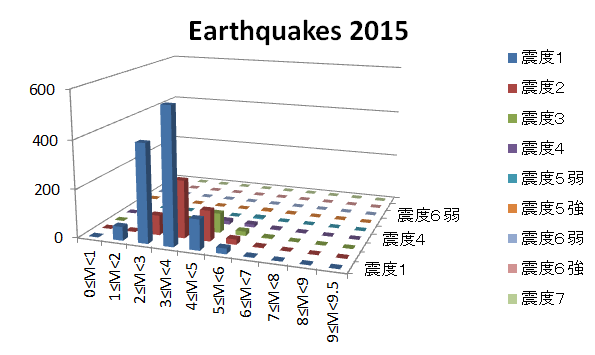
This is an overview of all the earthquakes in Japan in 2014, sorted per magnitude and shindo (震度, shaking intensity). This data was generated by using the Japan Meteorological Agency database.


The most earthquakes in a single category were shindo 1 and magnitude 3-3.9.
Shindo 1 earthquakes ranged from magnitude 0 to 6.9.
Shindo 2 earthquakes ranged from magnitude 1 to 6.9.
Shindo 3 earthquakes ranged from magnitude 1 to 6.9.
Shindo 4 earthquakes ranged from magnitude 3 to 7.9.
Shindo 5- earthquakes ranged from magnitude 5 to 5.9.
The Shindo 5+ earthquake fell into magnitude 5 to 8.9.
Below the frequency distribution of earthquakes during the year is shown (click to enlarge):


Shindo 1 earthquakes ranged from magnitude 0 to 6.9.
Shindo 2 earthquakes ranged from magnitude 1 to 6.9.
Shindo 3 earthquakes ranged from magnitude 1 to 6.9.
Shindo 4 earthquakes ranged from magnitude 3 to 7.9.
Shindo 5- earthquakes ranged from magnitude 5 to 5.9.
The Shindo 5+ earthquake fell into magnitude 5 to 8.9.
Below the frequency distribution of earthquakes during the year is shown (click to enlarge):

Friday, December 25, 2015
News in Japan - December
Japan:
556 bridges found to have bad supports:The devices are supposed to keep the bridges from collapsing during major earthquakes.
USA:
Key elements of digital disaster communications demystified: Messages describing hazard impacts and emphasizing cohesion among users generated the most "retweets". Other elements encouraging retransmission include the number of users in an agency's network and the inclusion of an agreed-upon hashtag. "Shorter messages are not necessarily simpler to write," said lead author Jeannette Sutton, director of the University of Kentucky's Risk & Disaster Communication Center. "We have decades of research on longer warning messages and practically none on short messages.
Texas tornadoes: Eleven killed in Dallas area: Eleven people have been killed in tornadoes in Texas, police say, with heavy rain and snow causing deaths and disruption in a number of other states. Further north, six people died in two incidents when cars drove into flooded roads in Missouri. Another driver was found dead in his car in a creek. Three adults and two children also drowned in southern Illinois when their vehicle was swept away.
Other:
Heavy floods in parts of South America (Dutch):Nearly 150,000 people in Paraguay, Argentina and Uruguay were forced to leave their houses due to floods. Most heavily affected was Paraguay (130,000 people), where a state of emergency has been declared and the president has already dedicated over 3 million euro as response funds. Over 125,000 people have lost power to their homes. Five people have died (4 from falling trees and one from electrocution).
According to the methods used in my latest published paper, these victims would not technically be counted as flood victims, as in that study, we excluded cases where victims died of causes unrelated to floods [such as being crushed by trees, falling from roofs, being blown off the road, or receiving electric shocks, and we found that 38% (122 victims) of the data relating to the 325 victims consisted of causes of death such as drowning (hypothermia or asphyxiation), heart attacks, or physical trauma during evacuation].
Vegetarian and 'healthy' diets are more harmful to the environment: "Eating lettuce is over three times worse in greenhouse gas emissions than eating bacon," said Paul Fischbeck, professor of social and decisions sciences and engineering and public policy. "Lots of common vegetables require more resources per calorie than you would think. Eggplant, celery and cucumbers look particularly bad when compared to pork or chicken." eating the recommended "healthier" foods -- a mix of fruits, vegetables, dairy and seafood -- increased the environmental impact in all three categories: Energy use went up by 38 percent, water use by 10 percent and GHG emissions by 6 percent.
Vulnerable People:
Child poverty could cost Japan $33 billion: The group predicted how their job prospects and lifetime earnings could change in 2 scenarios. One is that the government offers them assistance to go to high schools or colleges. The other is that the government doesn't take any action. The organization says the government's inaction would reduce the number of regular employees by 9,000 and leave 4,000 unemployed. It notes that this could result in a loss of about 24 billion dollars in their income, compared with when the government took action.


Subscribe to:
Posts (Atom)