Showing posts with label Water storage. Show all posts

Friday, October 28, 2016

News in Japan - October

USA

Other
Watersheds Lost Up to 22% of Their Forests in 14 Years. Here’s How it Affects Your Water Supply High erosion deteriorates water quality and reduces reservoir capacity, increasing the cost of water treatment and the risk of contamination. High erosion risk is usually linked to erodible soil, intense rainfall, steep topography and conversion of forest and other natural lands to pasture, cropland and more.
How fast will we need to adapt to climate change? Using sea-level rise as a case study, researchers at Carnegie's Department of Global Ecology have developed a quantitative model that considers different rates of sea-level rise, in addition to economic factors, and shows how consideration of rates of change affect optimal adaptation strategies. If the sea level will rise slowly, it could still make sense to build near the shoreline, but if the sea level is going to rise quickly, then a buffer zone along the shoreline might make more sense. "It is a very different thing to adapt to a sea level that is three feet higher if you think that sea level will rise no farther after that, than to adapt to a sea-level rise that is three feet higher with the expectation that the seas will keep rising," remarked Soheil Shayegh, a former Carnegie postdoc and lead author of the study.
Reservoirs play substantial role in global warming The world's reservoirs are an underappreciated source of greenhouse gases, producing the equivalent of roughly 1 gigaton of carbon dioxide a year, or 1.3 percent of all greenhouse gases produced by humans.
Evaluating forecasting models for predicting rainfall from tropical cyclones more than 50 percent of the deaths associated with hurricanes from 1970 to 2004 were caused by fresh water flooding. And from 1981 to 2011, hurricane damage accounted for almost half -- $417.9 billion -- of the total monetary damage from all weather and climate disasters during that same time period (adjusted for inflation to 2011 dollars). Current models can forecast both where and how much rainfall a tropical cyclone will produce up to two days in advance. However, the forecast's accuracy decreased significantly when the prediction window increased to five days.
Hurricane Matthew is just the latest unnatural disaster to strike Haiti At least 1,000 people were killed when Hurricane Matthew battered the Tiburon peninsula in Haiti last week, destroying houses and displacing tens of thousands. Other experts describe disasters as “manifestations of unresolved development problems”. Therefore, disasters are not a natural phenomenon. Humans play a central role. As a result, a natural hazard such as Hurricane Matthew impacts each country in its path differently. We know that development, imposed by external forces that exploit the local labour force is not in the interest of the marginalised. A failure to respect human rights, local needs, the environment and human-environment relations simply creates disaster risk.
Scientists find link between tropical storms and decline of river deltas Lead researcher Professor Stephen Darby of the University of Southampton said: “Our study is the first to show the significant role tropical storms play in delivering sediment to large river deltas.  We show that although human impacts affect the amount of sediment in a river – cyclonic activity is also a very important contributing factor. These results are very significant because the Mekong’s sediment load is already declining as a result of upstream damming and other human impacts such as sand mining. Understanding the role played by changes in tropical cyclone climatology gives us a broader knowledge of the threats facing this delta and others like it around the world.” 
Receding glaciers in Bolivia leave communities at risk  A new study published in The Cryosphere, an European Geosciences Union journal, has found that Bolivian glaciers shrunk by 43% between 1986 and 2014, and will continue to diminish if temperatures in the region continue to increase. "On top of that, glacier recession is leaving lakes that could burst and wash away villages or infrastructure downstream," says lead-author Simon Cook, a lecturer at the Manchester Metropolitan University in the UK.

Wednesday, June 8, 2016

ICWRER day 3

I presented today, on the final conference day of the International Conference on Water Resources and Environment Research. But first we enjoyed a keynote speech from Mathias Kondolf from the University of California, Berkeley, who talked about "Maintaining and Restoring Sediment Load Downstream of Dams". This included the tedious and costly process of re-sedimentation on the Rhine river, and current geomorphic impacts on the Mekong Delta. 


Tuesday, June 7, 2016

ICWRER day 2

The second day of the International Conference on Water Resources and Environment Research in Kyoto featured two keynote speeches. The first, from Prof. Hubert Savenije from the Dutch Delft University of Technology, touched upon drought models and root zone storage. He explained how different drought models led to opposite results for the Netherlands, and a local model often functioned better than a global one. He further set out his theory how most of the traditional ground storage models did not account for root storage correctly. These models assume that plants would use the entire soil depth to grow roots in, when in practice this was not the optimal growth strategy for plants. In fact, especially in moist areas, there is no need for plants to have deep roots as they can already gather enough moisture from the top soil layer, and then invest more in growing above ground. 


Monday, June 6, 2016

ICWRER day 1

The International Conference on Water Resources and Environment Research opened on Sunday, June 5th with a welcome icebreaker. The actual conference was opened the next day with a keynote speech from Prof. Eiichi Nakakita from the Kyoto University, who spoke on the SOUSEI project, that ICHARM is also a part of, which has as goal to integrate research activities on climate change and natural hazards.  


Another presentation of importance today was given by Guillermo Q. Tabios III, who chaired the topic of Sustainable Water Resources Management (G14). His presentation was titled "Multipurpose, Single High Dam versus Multiple Dam System for Balog-Balog Irrigation Project in the Philippines", and detailed the costs and water usages of several dams in the Philippines.


Friday, May 6, 2016

The Benefits of Cyclones

It's been over a year since the World Water Forum in Korea, where one of the members of the typhoon committee argued the necessity of studying the benefits of cyclones, which I since then did. Preceding a presentation at the 7th International Conference on Water Resources and Environment Research  in Kyoto, June 5-9, I here provide an overview of the literary findings of benefits of cyclones.

Cyclones often cause heavy damages and destruction to infrastructure and human lives, but the potential benefits of cyclones remain understudied. Several of these benefits could serve as an integral part of ecosystem based disaster risk reduction plans, when viewed as ecosystem services. For this purpose, we examined how the benefits of cyclones could be valued as ecosystem services. In phase one of this study, we scrutinized existing studies regarding potential benefits of cyclones.


The image shows a compilation of the 14 benefits of cyclones as described in the gathered studies on the topic, which we organized by approximate location (troposphere, biosphere, epipelagic zone) and order (cause and effect) of occurrence. More details follow after the break below.

Wednesday, March 30, 2016

News in Japan - March

GEJET:
Japan marks 5 years since the 3/11 disaster The Reconstruction Agency says at least 3,407 people died in 10 prefectures due to health problems and other reasons related to their lives as evacuees. The agency adds that as of February 12th, more than 174,000 people were living in temporary, rental or other housing as evacuees.
The Fukushima cleanup will take generations The cleanup team is still struggling to halt the buildup of contaminated water, and the techniques and equipment needed to locate, extract, and dispose of the melted fuel have yet to be developed. Given these challenges, many experts are convinced that the decommissioning process will take far longer than the official 40-year timetable-perhaps as long as a century. Rainwater and groundwater have continued to pour into the damaged basements of Units 1-4, where it mixes with the highly radioactive cooling water already inside the buildings. The pillars of TEPCO's water management efforts to date are two systems for channeling groundwater away from the contaminated basements and releasing it into the ocean relatively free of radioactive contaminants. One, the groundwater bypass system, collects water in wells dug between the reactor buildings and the hills to the west. The water is pumped up from the wells, tested, and eventually released into the ocean. The other, called the subdrain system, uses wells dug around the perimeter of the reactor buildings. So far, TEPCO has discharged some 230,000 tons of water into the ocean using these two methods combined. Even so, groundwater continues to pour into the buildings' basements at the rate of about 150 tons a day.
Lessons from Fukushima An RJIF study of hospital responses to the disaster found medical care for the afflicted was only able to continue at significantly reduced capacity because kizuna — social solidarity built upon people-to-people bonds, social networks and personal contacts — swung into action to mobilise armies of volunteers in forming the core engine of recovery. It was the residents of Fukushima who heroically banded together to manage the crisis. ‘[I]t is an unfortunate reality that in 2011 Japan had to resort to kizuna, even during the initial phase of crisis management, due to inadequate centralised management…Japan must now look beyond kizuna and build a crisis response apparatus that doesn’t overly rely on the goodwill of the Japanese people’. The people of Japan deserve better than having to rely on kizuna next time round. ‘To date, the NRA has received safety review applications for a total of 25 of the 43 existing commercial reactors’, Koppenborg reports. Commercial interests now have to face up to the NRA’s new regulatory teeth. It appears unlikely that further applications will be made and not all of these 25 applications can count on being successful. But ‘if Japan is to meet its goal of generating 20–22 per cent of its power through nuclear energy by 2030 it needs to reopen 30 reactors’, says Koppenborg. Richard Samuels argues that ‘perhaps the most striking development in the weeks and months after the devastation was how champions of existing institutions, practices, preferences and ideas — even those that failed so spectacularly and so indisputably — rallied to define the lessons that would be drawn. Political entrepreneurs from every corner framed the catastrophe to justify, legitimate, fortify and sell their pre-existing preferences. Japanese politics became a competition for control of who would define the heroes and the villains of the tragedy — and for the power to determine what would come next. Five years on, the 3.11 master narrative is still under construction’. This mindset is a key obstacle in the political gridlock that blocks improved disaster preparedness and strengthening Japan’s crisis management system as well as a more wholehearted approach to renewable energy sources.
Japan’s 3.11 master narrative still under construction In short, few agreed on policy alternatives, but everyone insisted that 3.11 proved they had been right all along. So where are we five years later? Were civic activists who argued that systemic dysfunctions in Japan can now be fixed correct? Or was one parliamentarian right when he suggested that 3.11, as colossal as it was, may not have been big enough to stimulate substantive institutional change? The evidence is mixed. The popularity of the Abe administration notwithstanding, opinion polls in the years after 3.11 suggest that the public is disillusioned with government. In 2013 large majorities reported that they believed reconstruction funds were wasted. Trust in government increased for a time, but recent data show that it has fallen and is below the global average.

Japan:
LDP to tackle 'taboo' of expanding foreign labor force Japan's ruling party kicks off a debate this month on whether to expand the pool of foreign workers to cope with a graying, shrinking population, challenging a longstanding "taboo" on immigration. But rather than rely on immigration, Prime Minister Shinzo Abe wants to focus on drawing more women and elderly into the workforce to fill the gaps, and has made raising Japan's rock-bottom birthrate a priority. The only way to ensure growth was to increase the size of the workforce, Kimura said in an interview, adding that monetary and fiscal policies were reaching the limit of their capacity to spur growth.

USA:
Single By Choice: Why Fewer American Women Are Married Than Ever Before When I say "the choice to not marry," that doesn't always translate into "I am a woman and I am deciding that I am not going to get married," or "I am rejecting marriage." The choice to not marry can also mean: "I would really like to marry or to fall in love or to meet someone, but I haven't met someone who I feel is going to improve on the life that I am building and making on my own." One of the most startling statistics is that today only 20 percent of Americans aged 18 to 29 are married, and that compares to 60 percent in 1960. The other figure that I find very startling, in part because it was so resilient for so long, is the median age of first marriage for women. From the time they started recording it — which was 1890 — until 1980, that median age of first marriage for women fluctuated only between 20 and 22. In 1990 it jumped to over 23, which is a huge jump from having been in that small range for so long. Today, for women, it is over 27. So if you're just looking at the sort of historical picture, there's this relatively flat line for almost 100 years and now there's not just a jump over that line, but way over that line.
Research will help policymakers plan for sea level rise (USA) A new study could help protect more than 13 million American homes that will be threatened by rising sea levels by the end of the century. It is the first major study to assess the risk from rising seas using year 2100 population forecasts for all 319 coastal counties in the continental US. Previous impact assessments use current population figures to assess long-term effects of coastal flooding.
Wetland enhancement in Midwest could help reduce catastrophic floods of the future (USA) New financial models and flood management policies may be needed to actually accomplish this. If just 1.5 percent of the land were used for wetlands, the peak flow of the overall watershed could be reduced by up to 17.5 percent.

Netherlands:

Other:
When sea levels rise, damage costs rise even faster A team of scientists from the Potsdam Institute for Climate Impact Research (PIK) now provides a method to quantify monetary losses from coastal floods under sea-level rise. For the first time, the scientists show that the damage costs consistently increase at a higher rate than the sea-level rise itself.
Citizen science to prevent the effects of floods (Spain) Researchers from UPM are involved in the development of a mobile phone application that allows user to share information about floods and their effects aiming to help researchers.
The best way to protect us from climate change? Save our ecosystems There is now clear evidence that intact forests have a positive influence on both planetary climate and local weather regimes. Forests also provide shelter from extreme weather events, and are home to a host of other valuable ecosystems that are important to human populations as sources of food, medicine and timber. In Vietnam, 12,000 hectares of mangroves have been planted at a cost of US$1.1 million, but saving the US$7.3 million per year that would have been spent on maintaining dykes. In Louisiana, the destruction of Hurricane Katrina in 2005 led to an examination of how coastal salt marshes might have reduced some of the wave energy in the hurricane-associated storm surges. Data have now confirmed that salt marshes would have significantly reduced the impact of those surges, and stabilised the shoreline against further insult, at far less cost than engineered coastal defences. With this data in hand, discussions are now beginning around how to restore the Louisiana salt marshes to insulate against future extreme weather events.
Climate change is a potent element in the deadly brew of disaster risk Are we getting better at managing disasters, or are we actually reducing disaster risk? There is a significant difference between the two, and addressing that difference should have a profound impact on development.  at least 90% of disasters linked to natural hazards are climate related. Mortality is declining in many places because of better disaster management andmore effective use of early warning systems. But more needs to be done to reduce risk comprehensively, including by tackling the compounding factors of poverty and inequality, rapid and unplanned urbanisation, damage to eco-systems, and poor risk governance. More national disaster loss databases to guide investments should be established.
Paris prepares for possible deluge similar to 1910 Great Flood More than 100 years ago, the Seine River rose 8m above its usual level following months of high rainfall, causing the catastrophe known as the Great Flood of Paris. There were no deaths but it took around 35 days for the water to clear.
Each year there is a one in 100 chance that a flood of that scale will occur in Paris again. The exercise will be carried out as if the river levels are rising by 50cm each day, allowing 900 emergency personnel, 150 police officers and 40 emergency vehicles to practice the necessary steps they will have to take. The exercise will also test how almost 90 public and private institutions such as hospitals, energy firms and waste disposal companies cope with the situation. “The difference between 1910 [and now] is that at that time we didn’t have telephone lines, the subway or electrics running underground. Now... if you have water [underground], everything will [go] down". The flood could cover an area measuring 500sq/km and affect the 830,000 people who live in the zone. More than 430,000 homes would be exposed to water as well as 100,000 businesses. Rectifying the damage could cost the city up to £15.5 billion.

Speeding up accuracy of flood risk assessment (Australia) The new method tested by the research team is aimed at providing a highly accurate assessment at a much faster rate. The method (known as hybrid causative events, or HCE) relies on an algorithm that knocks out all of the unnecessary information used by the slower, continuous simulation approach -- such as long, dry periods without rainfall.  It might take another five years or so for this method to be available to industry.
Adaptation to increasing flood risk in Europe should aim to reduce impact Scientists investigated the benefits of four adaptation measures to reduce the increasing flood risk in Europe under state-of-the-art global warming projections under a high-end climate scenario. Adaptation measures include the rise of flood protections, reduction of the peak flows through water retention, reduction of vulnerability and relocation to safer areas. According to the study, adaptation efforts should favour measures targeted at reducing the impacts of floods, such as relocation and vulnerability reduction, rather than trying to avoid them. Reducing vulnerability includes early warning systems, dry and wet flood proofing, and floating buildings, among others. Conversely, adaptation plans only based on rising flood protections have the effect of reducing the frequency of small floods and exposing the society to less-frequent but catastrophic floods and potentially long recovery processes. 
Can improved agricultural practices help combat climate change? Did you know that over half of global non-carbon dioxide (non-CO2) greenhouse gas (GHG) emissions are accountable to agriculture?  
'Unprecedented' storms and floods are more common than we think (UK) They conclude that 21st-century flood events such as Storm Desmond are not exceptional or unprecedented in terms of their frequency or magnitude, and that flood frequency and flood risk forecasts would be improved by including data from flood deposits dating back hundreds of years. "Conventional methods of analysing river flow gauge records cannot answer these questions because upland catchments usually have no or very short records of water levels of around 30 or 40 years. In fact, recent careful scientific analysis of palaeoflood deposits (flood deposits dating back hundreds of years) in the UK uplands shows that 21st-century floods are not unprecedented in terms of both their frequency (they were more frequent before 1960) and magnitude (the biggest events occurred during the 17th–19th centuries)." Professor John Lewin from the University of Aberystwyth said: "What is needed, is far more resilience for already-developed floodplains, and much more serious insistence that future floodplain development should be virtually curtailed. Somewhere along the line floodplain development has been allowed by local authorities and the UK government to continue regardless."

Vulnerable people:
One-third of working women in Japan sexually harassed: study  The study, released Tuesday and the first of its kind, examined responses from more than 9,600 women employees, submitted by mail or online. The response rate was 18%. Of the respondents, 29% said they had suffered sexual harassment. The most common type of harassment was having their appearance or age become the focus of conversation, at 54%. The next most common was unwanted touching at 40%, followed by sexually related questions at 38%. Twenty-seven percent were asked out for meals and dates. 
Few women in higher management Netherlands (Dutch) Results from the report http://www.grantthornton.global/globalassets/wib_turning_promise_into_practice.pdf show that only 18% of positions in higher management are held by women in the Netherlands. Japan scores lowest of researched countries with 7%, and Russia highest with 45%.
Japan rejects U.N. panel view on 'comfort women' Japan rejected on Tuesday a U.N. panel's view that Tokyo should take into consideration the opinions of so-called comfort women in implementing a bilateral agreement reached with South Korea last year. "The (panel's) conclusion does not sufficiently reflect the Japanese government's explanation and is regrettable," Foreign Minister Fumio Kishida told reporters. The U.N. Committee on the Elimination of Discrimination against Women said Monday the agreement did not fully adopt a victim-centered approach to address the issue of women who were procured for Japan's wartime military brothels.
1 in 29 babies born in Japan in 2014 had non-Japanese parent The number of babies whose parents are both non-Japanese totaled about 15,000, compared with 20,000 who were born to Japanese and non-Japanese couples, according to the ministry data.
How People Learn to Become Resilient If you are lucky enough to never experience any sort of adversity, we won’t know how resilient you are. It’s only when you’re faced with obstacles, stress, and other environmental threats that resilience, or the lack of it, emerges: Do you succumb or do you surmount? Not all of the at-risk children reacted to stress in the same way. Two-thirds of them “developed serious learning or behavior problems by the age of ten, or had delinquency records, mental health problems, or teen-age pregnancies by the age of eighteen.” But the remaining third developed into “competent, confident, and caring young adults.” They had attained academic, domestic, and social success—and they were always ready to capitalize on new opportunities that arose. A resilient child might have a strong bond with a supportive caregiver, parent, teacher, or other mentor-like figure. But another, quite large set of elements was psychological, and had to do with how the children responded to the environment. The resilient children had what psychologists call an “internal locus of control”: they believed that they, and not their circumstances, affected their achievements. The resilient children saw themselves as the orchestrators of their own fates. In fact, on a scale that measured locus of control, they scored more than two standard deviations away from the standardization group. One of the central elements of resilience, Bonanno has found, is perception: Do you conceptualize an event as traumatic, or as an opportunity to learn and grow? “Events are not traumatic until we experience them as traumatic.” Werner found that resilient individuals were far more likely to report having sources of spiritual and religious support than those who weren’t. You can train people to better regulate their emotions, and the training seems to have lasting effects. Unfortunately, the opposite may also be true. “We can become less resilient, or less likely to be resilient,” Bonanno says. “We can create or exaggerate stressors very easily in our own minds. That’s the danger of the human condition.” 
First gender identity disorder doctors certified in Japan  The society eventually hopes to make the cost of hormone therapy and gender reassignment surgery, which is currently fully shouldered by the patients, covered by national health insurance.

Monday, February 29, 2016

News in Japan - February

USA:
History Doesn’t Repeat Itself—Not Here, Anyway (USA). After discussions and deliberation between cities, states, and the federal government, many of these flood-damaged and flood-prone lands were converted into open space through government acquisitions, or “buyouts.” After 1993, parks and fields were created where homes had once stood. These areas were now easier to maintain and protect. Children could play football or soccer. Families could picnic in the summertime and build snowmen in the winter.
Record Missouri flooding was manmade calamity, scientist says Most news reports blamed it on the heavy rain, but a professor of earth and planetary sciences says analysis of the flood data shows much of the damage was due to recent modifications to the river. The flood on the middle Mississippi River, in turn, was remarkable for its short duration and the time of year. "It was essentially a winter flash flood on a continental-scale river," Criss said. "The Mississippi has been so channelized and leveed close to St. Louis that it now responds like a much smaller river." "In the meantime," he said, "inaccurate Federal Emergency Management Agency flood frequencies based on the assumption that today's river will behave as it has in the past greatly underestimate our real flood risk and lead to inappropriate development in floodways and floodplains." "The heavy rainfall was probably related to El Niño, and possibly intensified by global warming. But new records were set only in areas that have undergone intense development, which is known to magnify floods and shorten their timescales. "People want to blame the rain, but this is mostly us," Criss said. "It's a manmade disaster." During the New Year's flood, roughly 7,000 buildings near St. Louis were damaged, two interstate highways were closed for several days, the community of Valley Park was evacuated, and two Metropolitan Sewer District plants were swamped so that sewage was dumped directly into the water. The flood killed more than 20 people in Missouri and Illinois, caused several hundred million dollars of damage, and left millions of tons of debris in its wake.
The best way to protect us from climate change? Save our ecosystems There is now clear evidence that intact forests have a positive influence on both planetary climate and local weather regimes. Forests also provide shelter from extreme weather events, and are home to a host of other valuable ecosystems that are important to human populations as sources of food, medicine and timber. In Vietnam, 12,000 hectares of mangroves have been planted at a cost of US$1.1 million, but saving the US$7.3 million per year that would have been spent on maintaining dykes. In Louisiana, the destruction of Hurricane Katrina in 2005 led to an examination of how coastal salt marshes might have reduced some of the wave energy in the hurricane-associated storm surges. Data have now confirmed that salt marshes would have significantly reduced the impact of those surges, and stabilised the shoreline against further insult, at far less cost than engineered coastal defences. With this data in hand, discussions are now beginning around how to restore the Louisiana salt marshes to insulate against future extreme weather events.
Flavour of Dutch dialogues gets into 1 billion dollar US disaster resilience plans Morris has been closely involved in the competition and emphasises the tremendous Dutch influence in these projects. In particular, he mentions the climate adaptive approach that focusses on disaster prevention, and on the involvement of many stakeholders right from the start. "This is a distinct Dutch approach to urban planning", says Morris. "Also the involvement of landscape architecture shows the Dutch influence in these projects". "With the two competitions the housing department provokes the states and the local communities to think about their future and the social-economic development. The US is well organized on reactive disaster response. The competitions made them think of the future and long term planning for smart investments." 

Netherlands:

Vulnerable People:

Other:
With a 21 percent share of the national gross domestic product (GDP) and a 45 percent share of Pakistan's total workforce, it is crucial that agriculture be able to prevent and mitigate the impact of disasters.
Human-made climate change helped cause south of England floods, say scientists anthropogenic greenhouse gas emissions increased the risk of the once-a-century wet January in 2014 by 43% (uncertainty range: 0-160%). The heightened risk of rainfall found in the meteorological modelling led to an increase in the peak 30-day river flow of 21% (uncertainty range: -17-133%) and about 1,000 more properties at risk of flooding (uncertainty range: -4,000-8,000).
Borrowed Time on Disappearing Land (Bangladesh) “These migrants should have the right to move to the countries from which all these greenhouse gases are coming. Millions should be able to go to the United States.” Making matters worse, much of what the Bangladeshi government is doing to stave off the coming deluge — raising levees, dredging canals, pumping water — deepens the threat of inundation in the long term. In an analysis of decades of tidal records published in October, Dr. Pethick found that high tides in Bangladesh were rising 10 times faster than the global average. He predicted that seas in Bangladesh could rise as much as 13 feet by 2100, four times the global average. “The reaction among Bangladeshi government officials has been to tell me that I must be wrong,” he said. “That’s completely understandable, but it also means they have no hope of preparing themselves.” “There is no doubt that preparations within Bangladesh have been utterly inadequate, but any such preparations are bound to fail because the problem is far too big for any single government,” said Tariq A. Karim, Bangladesh’s ambassador to India. “We need a regional and, better yet, a global solution. The family reunited on the road the next day after the children spent a harrowing night avoiding snakes that had sought higher ground, too. They drank rainwater until rescuers arrived a day or two later with bottled water, food and other supplies. In the weeks after the storm, the women of Dakope found firewood by wading into the raging river and pushing their toes into the muddy bottom. They walked hours to buy drinking water. “I don’t want to stay here (slums) for too long,” Mr. Gazi said. “If we can save some money, then we’ll go back. I’ll work on a piece of land and try to make it fertile again.” But the chances of finding fertile land in his home village, where the salty rivers have eaten away acre upon acre, are almost zero.

Friday, December 25, 2015

News in Japan - December

Japan:
556 bridges found to have bad supports:The devices are supposed to keep the bridges from collapsing during major earthquakes.

USA:
Key elements of digital disaster communications demystified: Messages describing hazard impacts and emphasizing cohesion among users generated the most "retweets". Other elements encouraging retransmission include the number of users in an agency's network and the inclusion of an agreed-upon hashtag. "Shorter messages are not necessarily simpler to write," said lead author Jeannette Sutton, director of the University of Kentucky's Risk & Disaster Communication Center. "We have decades of research on longer warning messages and practically none on short messages. 
Texas tornadoes: Eleven killed in Dallas area: Eleven people have been killed in tornadoes in Texas, police say, with heavy rain and snow causing deaths and disruption in a number of other states. Further north, six people died in two incidents when cars drove into flooded roads in Missouri. Another driver was found dead in his car in a creek. Three adults and two children also drowned in southern Illinois when their vehicle was swept away.

Other:
Heavy floods in parts of South America (Dutch):Nearly 150,000 people in Paraguay, Argentina and Uruguay were forced to leave their houses due to floods. Most heavily affected was Paraguay (130,000 people), where a state of emergency has been declared and the president has already dedicated over 3 million euro as response funds. Over 125,000 people have lost power to their homes. Five people have died (4 from falling trees and one from electrocution).

According to the methods used in my latest published paper, these victims would not technically be counted as flood victims, as in that study, we excluded cases where victims died of causes unrelated to floods [such as being crushed by trees, falling from roofs, being blown off the road, or receiving electric shocks, and we found that 38% (122 victims) of the data relating to the 325 victims consisted of causes of death such as drowning (hypothermia or asphyxiation), heart attacks, or physical trauma during evacuation].
Vegetarian and 'healthy' diets are more harmful to the environment: "Eating lettuce is over three times worse in greenhouse gas emissions than eating bacon," said Paul Fischbeck, professor of social and decisions sciences and engineering and public policy. "Lots of common vegetables require more resources per calorie than you would think. Eggplant, celery and cucumbers look particularly bad when compared to pork or chicken." eating the recommended "healthier" foods -- a mix of fruits, vegetables, dairy and seafood -- increased the environmental impact in all three categories: Energy use went up by 38 percent, water use by 10 percent and GHG emissions by 6 percent.

Vulnerable People:
Child poverty could cost Japan $33 billion: The group predicted how their job prospects and lifetime earnings could change in 2 scenarios. One is that the government offers them assistance to go to high schools or colleges. The other is that the government doesn't take any action. The organization says the government's inaction would reduce the number of regular employees by 9,000 and leave 4,000 unemployed. It notes that this could result in a loss of about 24 billion dollars in their income, compared with when the government took action.


Friday, August 7, 2015

Visit to the Metropolitan Area Outer Underground Discharge Channel - part 4

Finally some photos from outside, underground in the channel itself, and the pumps in the main building. 


More information from previous visits to the MAOUDC can be found in these posts from August 2011 - August 2011 information - October 2011.

Visit to the Metropolitan Area Outer Underground Discharge Channel - part 3

We enjoyed watching the English video about the MAOUDC with students from the Tokyo University international summer course, who are learning to use the IFAS software at ICHARM this week. 
 
The command center from which the water volumes in separate sections can be managed.


 It was a cool 20 degrees at the bottom of the tunnel.


Visit to the Metropolitan Area Outer Underground Discharge Channel - part 2

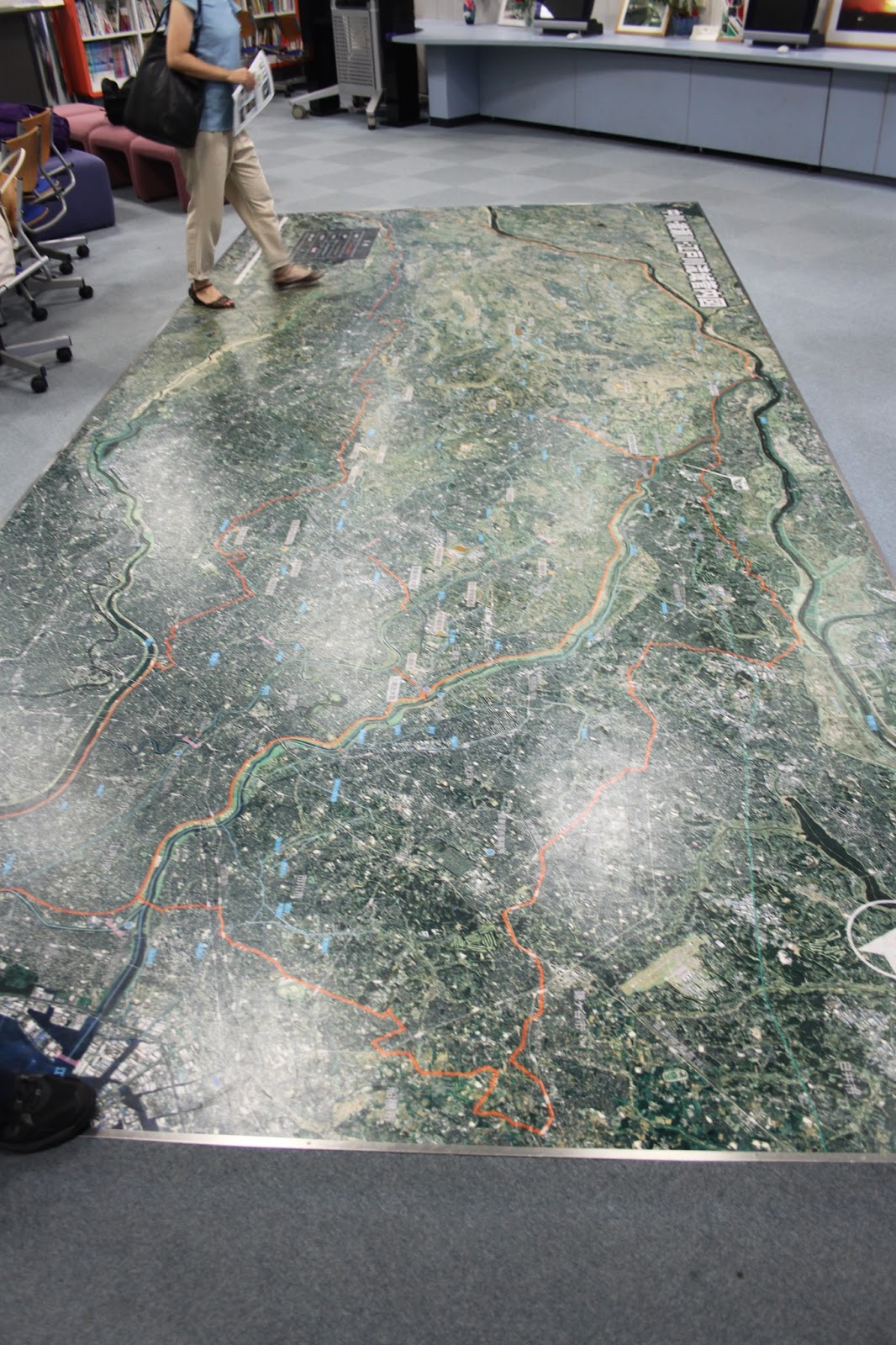
Not much has changed since my visits in 2011, but I did get the chance to take more pictures of the information boards in the hallway. 

The first map, with North to the left, shows the projects in the Edo river including super levees.


The next boards elaborate on the concept of super levees. Ideally the whole bank will be completed, but due to financial and political constraints it remains an ongoing process. Another impacting factor is that the prefectural boundary is chosen at the river course, so theTokyo Metropolitan Government is developing super levees on the west side of the river and not the opposite side.


This board shows the river disaster preparedness center.

Finally, something about the MAOUDC itself.

Here the water distribution between Edo, Naka and Ayase river is explained (more pictures of projects of lowland rivers in Tokyo here).

The various areas in Tokyo affected by the Edo river are shown on the right hand side.

This board goes far back into history, showing Tokyo bay 9,000, 5,500 and 4,000 years ago. The landscape and overall shape of the bay have changed dramatically, both enlarging and decreasing in size. As there used to be an inland sea, during the channel construction many sea shells and other remains of marine life were excavated.


The MAOUDC is chosen as one of the locations to see mount Fuji from.

A better picture of the 3D elevation map, showing the bowl structure Tokyo is in and how elevated the river levees are compared to the surrounding landscape.