Saturday, October 25, 2014

Delta plan Netherlands

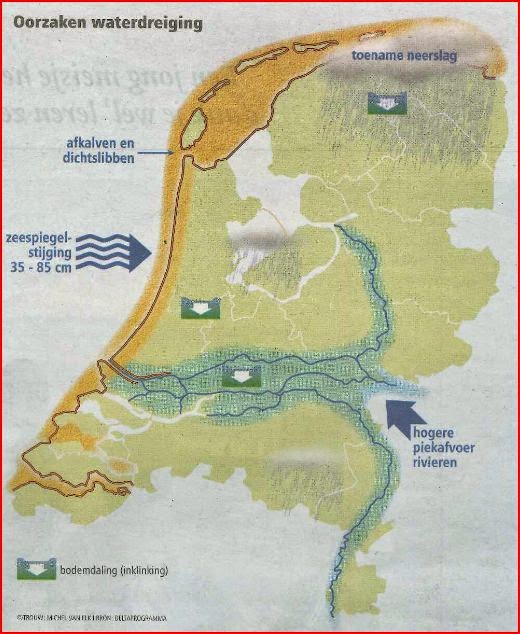
Last month the Dutch newspaper Trouw (19th September) reported on the new Dutch Deltaplan, made to counter the current water challenges. The Netherlands is facing increased river discharge, increased precipitation, and a sea level rise of about 35-85 cm, in combination with land subsidence. 


After the 1953 flood disaster safety levels of levees were calculated and levees were prepared accordingly. What was lacking consisted of maintenance (one third of the levees did not fulfill the original safety designs), and the norms were never recalculated to account for any changes, including climate change. The norms also didn't account for levee failures by droughts or by piping, where water seeps through underneath the levee. 

The new norms work differently. Rather than calculating the chance of floods, the chance of levee failure is used. Another change is to use the chance of dying from a flood rather than a flood occurrence. The new norm of acceptable safety is having a chance of 1 in 100,000 to die as a consequence of floods. The standard safety norms for other disasters such as dangerous compounds is 1 in 1,000,000. The reason floods have a higher chance is mainly that it is impossible to arrange physical infrastructure to reach the 1,000,000 safety norm. Furthermore, it is assumed that 1% of all people will drown once a polder is flooded. If the current status of the levee indicates that more people might drown, this levee is up for revision. The new Delta program calculated that over 200 levee areas will have stricter norms.

Other issues still remain, such as the traditional issue of flooding abroad. If the rivers flood in Germany, the water will enter the Netherlands not through the improved rivers, but over land unprotected by levees.

Monday, October 20, 2014

Dissertation published online

GRIPS has published my dissertation titled "Vulnerable People and Flood Risk Management Policies". You can find it here.

Keywords: Disaster Risk Management, disaster law, vulnerable people, social vulnerability, flood, evacuation

Abstract:
The main goal of this study is to evaluate the measures for vulnerable people in Disaster Risk Management (DRM) policies focusing on floods. There are many groups of potentially vulnerable people (e.g., older adults, people with disabilities, people living in poverty) whose characteristics are not accounted for in emergency plans; vulnerable people require more attention if they are to experience an equal disaster risk level.
The original contributions of this study are as follows: a proposal of definitions for vulnerable people and groups of potentially vulnerable people; a theoretical framework with indicators focusing on six groups of vulnerable people; an overview of the potentially vulnerable people for flood hazards in the Netherlands, Japan, and the United States; and a metric designed to evaluate DRM policies, from national to subnational and regional levels.
The results reveal that the top 10 indicators account for 80% of all (gross sum of) potentially vulnerable people, 7 of which are identical. These top 10 indicators can serve as a starting point in order to increase the resilience of the vulnerable population. These 3 countries can learn from each other’s measures regarding the 7 identical indicators, and possibly apply them in their own area. The metric shows that DRM laws rarely anticipate a future increase in the number of potentially vulnerable people, and none of the laws were created by involvement of potentially vulnerable people. We count on our governments to make equitable policies, but this has clearly not yet been established in these developed, democratic countries.


Thursday, October 2, 2014

Published paper

The Journal of Disaster Research has published my article titled "A Quantitative Estimate of Vulnerable People and Evaluation of Flood Evacuation Policy", which contains the main research results of my doctoral dissertation. This is an open access journal, you can become a member by registering for free and access all articles published.

Abstract
Disaster Risk Management (DRM) laws and policies ideally contain measures to reduce disaster risk to all exposed people equally, even the most vulnerable people. To investigate this, we estimate the number of potentially vulnerable people in areas exposed to flood hazard, and evaluate the laws and policies which aim to reduce vulnerability. We proposed a theoretical framework based on four recognized characteristics of vulnerability (less physically or mentally capable; fewer material and/or financial resources; less access to information, and restricted by commitments) and created indicators for six groups of potentially vulnerable people: children, older adults, minorities, people with disabilities, people living in poverty, and women. We applied the framework to the populations of Japan, the Netherlands, and the United States, and proposed a new DRM policy evaluation method; and found that measures in DRM laws and policies are not in proportion to the number of potentially vulnerable people. The most numerous indicators included children aged 0-14, women with no car, and people with pets. The top ten indicators account for 80% of all potentially vulnerable people. When addressing the needs of vulnerable people from a policy perspective, these top ten indicators may serve as a starting point in order to increase the resilience of the vulnerable population. Seven of these ten are identical across the three case study countries, meaning the countries can learn from each other’s measures and possibly apply them in their own area. Policy evaluation showed that while many laws and policies do recognize various groups of potentially vulnerable people, they lack detailed support measures. Much remains to be amended in policies on all scale levels if the policies are to realize an equal disaster risk for all exposed people.

Journal ref: Journal of Disaster Research, Vol.9, No.5 pp. 887-900, 2014
Received: June 17, 2014
Accepted: August 7, 2014
Published online: 02 Oct 2014
DOI: 10.20965/jdr.2014.p0887
Indexed in Scopus, Compendex (Ei)

Wednesday, September 10, 2014

Symposium "Policy studies on huge disasters"

Hosted at GRIPS, this symposium featured two keynote speeches by experts and a panel discussion with the following members:

  • Mr. Tetsuro Ito (Guest Professor, The University of Tokyo, Former Chief Cabinet Secretary for Crisis Management)
  • Mr. Takahito Iwata  (Director of Emergency Management Department, Shizuoka Prefectural Government)
  • Mr. Hajime Kagiya   (General Manager of Secretariat to the Assembly, Itabashi Ward Tokyo, Lecturer of Hosei University)
  • Prof. Keiko Tamura (Professor, Risk Management Office at Niigata University, Former member of Central Disaster Prevention Council)
  • Prof. Haruo Hayashi (Keynote speech 1 “Huge disasters and Improvement of resilience”)(Professor and Director, Research Center for Disaster Reduction Systems, Disaster Prevention Research Institute Kyoto University)
  • Prof. Naoshi Hirata (Keynote speech 2 “Generating mechanism of the huge earthquake disasters”) (Professor and Director, Earthquake Prediction Research Center at The University of Tokyo)

While the speeches were mainly technical and focused on the GEJET 2011 and predictions of similar future events in other areas of Japan, the panel discussion allowed for a small widening of topics, most importantly because it was possible to hand in questions to the panel members. There were simultaneous English-Japanese translations, so the following information may contain translation errors.

During the speeches the current predictions of a magnitude 8-9 earthquake in the Nankai trough (South East Japan) in the coming 30 years has 60-70% chance of occurring and showed over 300,000 deaths and a 30m tsunami in Shikoku. It is expected to cost 420 billion yen to reduce the estimated victims.


Tokyo still has a high probability of a magnitude 7+ earthquake. Here the main cause of death in projections is estimated to occur by electrical fires (70% of all projected deaths), meaning policies are focusing on how to stimulate private house owners to improve their houses as the government taxes are not sufficient to pay for all individual improvements. The fires are predicted to last 2 days as firefighters won't be able to reach all locations and electricity is thought to be out for one week. No police or ambulance can travel on the road for about a month due to obstructions. The Tokyo population is still increasing, not to births which are actually less than the amount of deaths, but due to immigration.

Equally interesting was the predictions of a magnitude 7-8 earthquake in Hokkaido and more northern island, which are Russian. Here it was mentioned that for some disputed islands, it is legally unclear who is responsible to save the inhabitants, though of course the Japanese government would make any effort to save those in need of rescue regardless of nationality.

During the panel discussion several topics were brushed. Mr. Iwata explained about Shizuoka, which already has many communities of 25% older adults where communities may lose their functions and become isolated during a disaster due to the mountainous area and easily blocked roads. It may even be that the area cannot receive relief. Should the communities aim at being fully self-resilient or be interdependent?

Residents who refused to evacuate when ordered to do so during the GEJET came in two categories, as explained by Prof. Tamura. The first wanted to claim damages, thought they understood the water level, and didn't acknowledge the tsunami. This could be addressed with by more education and adaptability. The second just couldn't pull themselves away from daily life, due to e.g. medication. This also requires more education during the normal routine, think about how you can be comfortable evacuating, and by keeping precious belonging nearby and ready to take with you.

Prof. Hirata commented on the possible eruption of mount Fuji, which was met with laughter. He said explosions are never sudden, there are several predicting phenomenon observed before eruptions. Some of those signs can be detected, and there are none right now. The magazine and press reports are without substance. During a magnitude 5 earthquake there were volcanic eruptions, so there will be a slightly higher chance for Fuji to erupt during a magnitude 9 earthquake. It could occur in the coming 50 years, a hazard map is available.
Mr. Iwata added that there is an evacuation plan coordinated between 3 prefectures which will be rehearsed next month and focuses on pyroclastic flow. One difficultly for the Nankai trough earthquake is that several eruptions are expected, roads will be damaged, and a small flow will already result in 200,000 evacuees, which is very difficult to manage.

Mr. Ito commented on local disaster drills. Always the same people visit the drills, but they would like to train specifically young mothers and students. There are not enough people to organize workshops on the community level. He also said that having a nice plan with pictures does not mean implementation is easy. For individuals, he recommends to make a disaster plan beforehand with your family based on the assumption that you are still alive and the shelters work. You should have water and food, and be fully prepared to protect yourself.

Mr. Ito also mentioned the relocation of (governmental functions of) Tokyo, which has been discussed many times and abandoned for various reasons. Can the ministries in Kasumigaseki survive? How can this, and the stock exchange, be maintained? Do the backup offices function? These questions remained unanswered.

All in all it was a highly educational discussion with comments from experts in all policy levels as well as from various parts of the country, each adding their valuable experiences.
Friday, September 5, 2014

Published paper

The journal Water International (since 1975) has published my article titled "Transboundary water law and vulnerable people: legal interpretations of the ‘equitable use’ principle". This could be the focus of a future postdoc.

Abstract

Vulnerable people require additional measures to ensure their water capabilities, as they have certain characteristics making them more vulnerable than others. As pointed out by recent studies, transboundary water access laws and policies do not sufficiently address the needs of vulnerable people. The prevailing legal arrangements often only address extrinsic vulnerability and forgo focusing on intrinsic vulnerability, which creates the need for different transboundary water legislation. This paper shows how international treaties can address the right to certain water capabilities by considering not merely the current but also future global populations into the creation of their transboundary agreements.

DOI:10.1080/02508060.2014.951827
Volume 39, Issue 5, 2014, pages 743-754
Received: 12 May 2014
Accepted: 30 Jul 2014
Published online: 02 Sep 2014
2013 Impact Factor: 0.639

Monday, September 1, 2014

Bousai no hi (Disaster Preparedness Day)

September 1 is disaster preparedness day in Japan. Most governmental organizations and schools will hold a disaster drill around this time. This is also a good time to check your own disaster preparedness kit for completeness and expiration dates, as well as check how your work/study place is prepared. Do you know the nearest emergency exit?

At GRIPS I saw that the lounge on the fifth floor, which is the floor that also has most of the student desks, has a large amount of helmets in boxes. Unfortunately this means the helmets cannot be used during an emergency, as students would first have to go to the lounge, unpack the helmets, and fit them, before being able to protect their heads. If you get a helmet, keep it under your desk and make sure beforehand to adjust the straps so that it fits your head when you need it. If there is a major earthquake, you are likely to want immediate protection, not after 3-5 minutes.


While being under-prepared helmet wise, GRIPS does have warning signs on top of lockers to minimize  the amount of items that might fall on your head (now it is only these cardboard warning signs).


The Aeon supermarket was also promoting disaster preparedness and selling goods for survival packages at home.


In other news, the mame-shiba are now informing people about water pipes in the subways.