Wednesday, December 30, 2015

Earthquakes Japan 2015

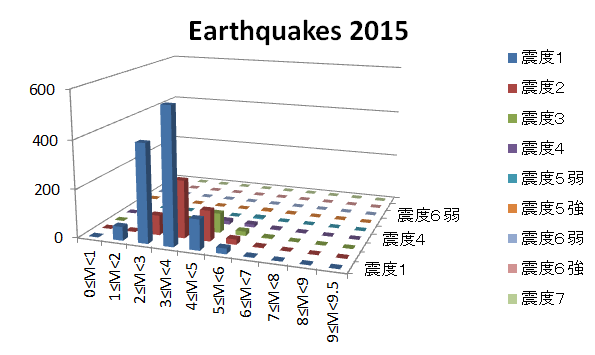
This is an overview of all the earthquakes in Japan in 2014, sorted per magnitude and shindo (震度, shaking intensity). This data was generated by using the Japan Meteorological Agency database.


The most earthquakes in a single category were shindo 1 and magnitude 3-3.9.
Shindo 1 earthquakes ranged from magnitude 0 to 6.9.
Shindo 2 earthquakes ranged from magnitude 1 to 6.9.
Shindo 3 earthquakes ranged from magnitude 1 to 6.9.
Shindo 4 earthquakes ranged from magnitude 3 to 7.9.
Shindo 5- earthquakes ranged from magnitude 5 to 5.9.
The Shindo 5+ earthquake fell into magnitude 5 to 8.9.

Below the frequency distribution of earthquakes during the year is shown (click to enlarge):

Friday, December 25, 2015

News in Japan - December

Japan:
556 bridges found to have bad supports:The devices are supposed to keep the bridges from collapsing during major earthquakes.

USA:
Key elements of digital disaster communications demystified: Messages describing hazard impacts and emphasizing cohesion among users generated the most "retweets". Other elements encouraging retransmission include the number of users in an agency's network and the inclusion of an agreed-upon hashtag. "Shorter messages are not necessarily simpler to write," said lead author Jeannette Sutton, director of the University of Kentucky's Risk & Disaster Communication Center. "We have decades of research on longer warning messages and practically none on short messages. 
Texas tornadoes: Eleven killed in Dallas area: Eleven people have been killed in tornadoes in Texas, police say, with heavy rain and snow causing deaths and disruption in a number of other states. Further north, six people died in two incidents when cars drove into flooded roads in Missouri. Another driver was found dead in his car in a creek. Three adults and two children also drowned in southern Illinois when their vehicle was swept away.

Other:
Heavy floods in parts of South America (Dutch):Nearly 150,000 people in Paraguay, Argentina and Uruguay were forced to leave their houses due to floods. Most heavily affected was Paraguay (130,000 people), where a state of emergency has been declared and the president has already dedicated over 3 million euro as response funds. Over 125,000 people have lost power to their homes. Five people have died (4 from falling trees and one from electrocution).

According to the methods used in my latest published paper, these victims would not technically be counted as flood victims, as in that study, we excluded cases where victims died of causes unrelated to floods [such as being crushed by trees, falling from roofs, being blown off the road, or receiving electric shocks, and we found that 38% (122 victims) of the data relating to the 325 victims consisted of causes of death such as drowning (hypothermia or asphyxiation), heart attacks, or physical trauma during evacuation].
Vegetarian and 'healthy' diets are more harmful to the environment: "Eating lettuce is over three times worse in greenhouse gas emissions than eating bacon," said Paul Fischbeck, professor of social and decisions sciences and engineering and public policy. "Lots of common vegetables require more resources per calorie than you would think. Eggplant, celery and cucumbers look particularly bad when compared to pork or chicken." eating the recommended "healthier" foods -- a mix of fruits, vegetables, dairy and seafood -- increased the environmental impact in all three categories: Energy use went up by 38 percent, water use by 10 percent and GHG emissions by 6 percent.

Vulnerable People:
Child poverty could cost Japan $33 billion: The group predicted how their job prospects and lifetime earnings could change in 2 scenarios. One is that the government offers them assistance to go to high schools or colleges. The other is that the government doesn't take any action. The organization says the government's inaction would reduce the number of regular employees by 9,000 and leave 4,000 unemployed. It notes that this could result in a loss of about 24 billion dollars in their income, compared with when the government took action.


Monday, December 21, 2015

Published Paper

The journal Water Policy has published an article by Sangeun Lee and myself titled "Assessing the vulnerability of different age groups regarding flood fatalities: case study in the Philippines". It is now available online in final form (a previous version was available in May). Although this publication is not open access, full PDF copies are available upon request.

Abstract (adapted to adjust html codes to proper screen coding)
This study aimed to identify age groups vulnerable to flood fatalities and quantify their vulnerability by means of statistical methods. First, the study obtained data of 122 victims directly resulting from five flood disasters in the Philippines over the period 2010–2013 which was used to compare the number of flood fatalities in each age group with the population numbers. The chi-square goodness-of-fit test shows that only one age group, people aged less than and up to 70, was vulnerable to flood fatalities. Vulnerabilities of people aged less than and up to 70 and over 70, respectively, were quantified in terms of mortality, i.e., the ratio of flood fatalities and affected people. This study obtained two lognormal distribution curves moderately describing histograms built with samples on the mortality of the two age groups. Based on probabilistic parameters of the selected lognormal distribution curves, the study concludes that people aged less than and up to 70 have more than three times the vulnerability to the risk of flood fatality than people aged over 70. It is also suggested that the age dependency ratio, which is widely used to consider demographic vulnerability in flood vulnerability studies, should not be applied to the Philippines.


Journal ref: Water Policy, December 2015, 17 (6) 1045-1061
Received: 12 May 2014
Accepted in revised form: 19 February 2015
Published online (uncorrected proof): 13 April 2015
Available online: 17 December 2015
DOI:10.2166/wp.2015.089
Impact Factor 2014: 0.833

Thursday, December 17, 2015

UNESCO ENHANS project meeting

ENHANCING NATURAL HAZARDS RESILIENCE IN SOUTH AMERICA

At this meeting Masahiko Murase from ICHARM explained the research and education activities at ICHARM, and Karina Vink showed three models used for different project: BTOP, IFAS and RRI. 

A program specialist of UNESCO requested more technical requirements of an IFAS training for the four target countries of the ENHANS project. The ENHANS project currently has as target countries: Ecuador, Chili, Peru, Uruguay. The first target for IFAS training would be Chili/Peru, possibly simultaneously as the target areas in these countries border each other (North Chili, South Peru). As training period May was suggested. 

The ENHANS meeting in Montevideo was successful as multiple parties expressed an interest in IFAS training and ICHARM models. As a next step a governmental request for IFAS training would aid in arranging the necessary required administrative steps and financing surrounding the organization of IFAS trainings abroad. ICHARM will continue to support and prepare for IFAS training in the ENHANS target countries if so requested.

Friday, November 27, 2015

News in Japan - November

Japan:
Study says Tokyo, Osaka, other mega-cities will be swamped by surging sea levels, even at 2 degrees Celsius rise A spike in Earth’s temperature of 2 degrees Celsius (3.6 degrees Fahrenheit) would submerge land currently occupied by 280 million people, while an increase of 4 degrees Celsius - humanity’s current trajectory - would cover areas populated by more than 600 million people, the study said.
In the capital, 7.5 million people - 30 percent of Tokyo’s population - would be affected by the sea level rise under the 4 C scenario. A rise by 2 C would leave 4.2 million people’s homes underwater.
In Osaka, 6.2 million people - a staggering 38 percent of its population - would be affected under the 4 C rise. Under the 2 C scenario, the city would still see 4.2 million affected.
Sea level rises corresponding to these 2 C or 4 C scenarios could unfold in two hundred years, but would more likely happen over many centuries, perhaps as long as 2,000 years, according to the research, published by Climate Central.

USA:
Study ranks six American cities on preparation for climate change
Houston-Galveston region could be better protected from impact of hurricanes and severe storms

Netherlands:
Room for the river programme completes its largest depolderingproject Noordwaard, the Netherlands
Current technologies for levee monitoring in the Netherlands

Other:
Images Show Impact of Sea Level Rise on Global Icons
Paying it forward in a digital age: A global community committed to a mapped world
Salmon crossing the road during flood

Published paper

Environmental Hazards has published the article 'Factors affecting the evacuation decisions of coastal households during Cyclone Aila in Bangladesh', of which I am proud to be co-author.

You can use this link to receive a free full copy, or find it here if you have access to the journal.

Abstract
Despite sincere efforts by concerned agencies and recent improvements in hazard warnings, thousands of at-risk people did not evacuate during Aila, a category-I tropical cyclone that struck southwestern coastal Bangladesh in 2009. This study investigated the responses of the people affected by Aila to cyclone warnings and associated evacuation orders, and unveiled behavioural aspects that explain why they did or did not comply with the evacuation orders. Utilising the primary data collected from 420 households living in the severely affected coastal sub-district Koyra, located in Khulna District, this study found that although more than 97% of the households had received cyclone warnings and evacuation orders before Aila's landfall, only around 26% had evacuated. We also examined this study's empirical findings for factors that had dissuaded people from complying with the evacuation orders. Relevant test statistics along with results from principal component analysis suggested that the significant and systematic absenteeism of households from disaster preparedness training appears to be one of the key determinants that affected their evacuation decisions, along with factors related to warning messages, the attributes of cyclone shelters, risk perception, and socioeconomic aspects. A number of recommendations are also presented in this study for people at risk to improve their evacuation rates in future emergencies, not only to save their own lives but also to save their livestock.


Journal ref: Environmental Hazards
Authors: Md. Nasif Ahsan, Kuniyoshi Takeuchi, Karina Vink & Jeroen Warner
Volume 15, Issue 1, 2016, pages 16-42
Received: 7 January 2015
Accepted: 28 October 2015
Published online: 26 November 2015
http://dx.doi.org/10.1080/17477891.2015.1114912
2014 Impact Factor: 0.868

Friday, November 20, 2015

Joso flood damage overview


The total damage costs are still being calculated as the Japanese fiscal year runs until April, but below a translated overview of the gathered damages so far can be found (click to enlarge).