While I always wanted to research how an emergency drill would function for people with disabilities, I had to forego this chance exactly because of the disability.
Tsukuba city had its annual disaster drill this Sunday. Due to typhoon 22, it was raining earlier that week on Wednesday morning, when I optimistically rushed outside in my rain suit. I went down the stairs faster than expected as I had slipped half way through, falling on my hand and back. I merrily avoided a scaphoid fracture. However in combination with the program I started to follow this month on Saturdays in Tokyo, it proved to be too much to also visit the drill this year. So instead, here is a movie of me in action last year.
Information:
Disaster Drill for Foreigners of Tsukuba
Disaster Drill will be provided for foreign residents.
Date & Time: Sunday, 6 October 8:30 - 12:00
Location: The entrance of the City Hall
Language: There will be interpreters for some languages.
Applicants: 30 people
Application: Apply by calling ore e-mail before the event.
Contact: Tsukuba International Association
phone:029-869-7675
e-mail: ohki@inter.or.jp
Thank you and we hope the drill will give you good hints.
Showing posts with label Drill. Show all posts
Showing posts with label Drill. Show all posts
Sunday, October 6, 2013

Sunday, November 11, 2012
Ninomiya House Drill
Ninomiya House organized its own fire safety drill, which was very exciting. It was combined with tips on earthquake safety, as earthquakes are also a likely cause of fire. The whole two hours were packed with activities.
First all people had to evacuate the building using stairs and safety exits, wearing protective helmets. We had to gather at a rendezvous park close-by, at which point everyone was accounted for per floor. Next was a fire fighting drill with lo and behold actual fires. The extinguishers contained water though, but the spray cans for kitchen fires seemed the real deal. The fire department showed how everything should be worked, and volunteers were actively sought to replicate each of the demonstrated actions.


"Fire!" This is the most important thing to do before actual fire fighting. Call out to your neighbors and make sure they hear you, then head in with the right equipment. Useful information was also given. As I expected, if the ceiling is on fire, run. Smoke kills 90% of people in fires, so always cover your mouth and stay low.
We were also taught how to activate emergency power generators, in case the power would fail on the weekend, and few staff would be available to help. Firetruck ladders can reach up to 40 meters, so escaping to a balcony would not be a problem. The water from the hoses however, came only about 3 stories.

Afterwards at the lecture we unexpectedly got to taste some emergency supplies. Ninomiya House has food and water available for all residents for 5 days! Now we can start to eat our own supply.

Monday, October 1, 2012
Tsukuba City Disaster Drill
Tsukuba City is very progressive in its disaster drills, in that it specifically invites foreigners to join actively in the drill and provides interpreters for them as well. Of course we joined, and we even ended up on the local television broadcast.
Around 30 foreigners were invited to sign up in total. After gathering at the City Hall entrance where we were greeted by interpreters, 5 people were asked to be active volunteers during the drill. The area behind City Hall, also used for fireworks festivals and other events, is actually the scheduled disaster practice area. The edges of the terrain were littered with tents and fold-able chairs for participants to relax, whether they were the fire brigade or local families. On one side information tents had been set up as well. The center proved most interesting with 3 houses and a pile of wood. Enough space was left between the center and the tents for the longest emergency vehicles to drive around.
The program was fully packed and after the mandatory greetings, the first demonstration was debris removal. Next was emergency hospital set up, with active involvement. Our group was called in to carry a dummy to an emergency site for revival by medical specialists, and ACCS was filming the whole setup.
Then a very exciting activity took place, as the search dogs from three different prefectures, Tokyo, Chiba and Ibaraki, were trained to find people inside a pretend collapsed house. After all three dogs confirmed the locations, the rescue team responded by cutting the house open and calling out to the 'victims' inside. If you are removed by the roof, you get extracted vertically! As soon as the people were brought to safety, the rescue team removed the house. This is to clear the imaginary streets of collapsed houses.
Around this time people got served emergency food and water, which was quite nice given the outside temperatures. 6 of the 35 sponsors included food companies or supermarkets. The cooperation with local food suppliers was very interesting. Next up was fixing gas, electricity and water supply lines.
Another drill to actively participate in was firefighting. One house fire was to be put out with a bucket line, whereas foreigners were given fire extinguishers for a second house. It was nice to practice with a real fire and real extinguisher for once, as most companies prefer to have water filled containers spraying at plasticized pictures of fire. We obtained a disaster prevention bag with a thermal blanket and other useful items.
At the information stands, we watched the simulated effects of liquefaction swallow a windmill and observed the power tools the military used to clear the streets after the Great East Japan Earthquake and Tsunami. Meanwhile, the roof of the city hall was being used as a helicopter drill site. We also took a look inside the mobile disaster unit, which had everything from a toilet to a fax machine, just in case city hall had to be abandoned. We can only hope more cities have such an active disaster prevention force, and interpreters as well.
Around 30 foreigners were invited to sign up in total. After gathering at the City Hall entrance where we were greeted by interpreters, 5 people were asked to be active volunteers during the drill. The area behind City Hall, also used for fireworks festivals and other events, is actually the scheduled disaster practice area. The edges of the terrain were littered with tents and fold-able chairs for participants to relax, whether they were the fire brigade or local families. On one side information tents had been set up as well. The center proved most interesting with 3 houses and a pile of wood. Enough space was left between the center and the tents for the longest emergency vehicles to drive around.
The program was fully packed and after the mandatory greetings, the first demonstration was debris removal. Next was emergency hospital set up, with active involvement. Our group was called in to carry a dummy to an emergency site for revival by medical specialists, and ACCS was filming the whole setup.
Then a very exciting activity took place, as the search dogs from three different prefectures, Tokyo, Chiba and Ibaraki, were trained to find people inside a pretend collapsed house. After all three dogs confirmed the locations, the rescue team responded by cutting the house open and calling out to the 'victims' inside. If you are removed by the roof, you get extracted vertically! As soon as the people were brought to safety, the rescue team removed the house. This is to clear the imaginary streets of collapsed houses.
Around this time people got served emergency food and water, which was quite nice given the outside temperatures. 6 of the 35 sponsors included food companies or supermarkets. The cooperation with local food suppliers was very interesting. Next up was fixing gas, electricity and water supply lines.
Another drill to actively participate in was firefighting. One house fire was to be put out with a bucket line, whereas foreigners were given fire extinguishers for a second house. It was nice to practice with a real fire and real extinguisher for once, as most companies prefer to have water filled containers spraying at plasticized pictures of fire. We obtained a disaster prevention bag with a thermal blanket and other useful items.
At the information stands, we watched the simulated effects of liquefaction swallow a windmill and observed the power tools the military used to clear the streets after the Great East Japan Earthquake and Tsunami. Meanwhile, the roof of the city hall was being used as a helicopter drill site. We also took a look inside the mobile disaster unit, which had everything from a toilet to a fax machine, just in case city hall had to be abandoned. We can only hope more cities have such an active disaster prevention force, and interpreters as well.
Monday, June 4, 2012
Field Trip to Kokai river drills
Last month while mount Tsukuba reflected in the watered rice paddies, we ventured to a private flood fighting drill at Kokai river's Asahigaoka town.
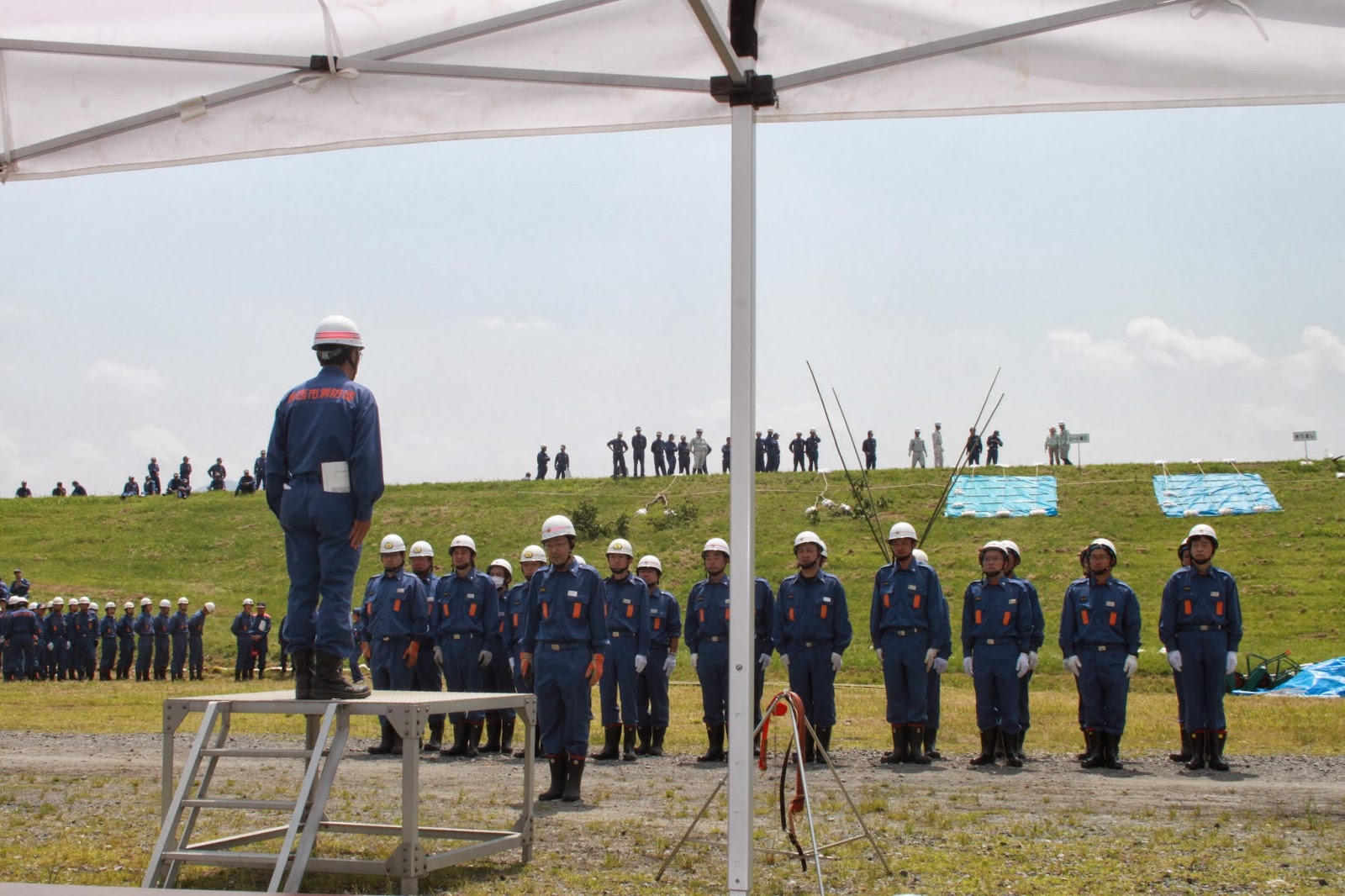
Asahigaoka was a rural area in great danger of flooding. As an example to other areas, all the residents were united in the plan to relocate the houses and industries to a concentrated elevated area, and redistribute the remaining land as low lying farm land. Two notable exceptions were a large industrial factory, and a cemetery, both still in the same location albeit on elevated land. The farm land doubles as a retarding basin, and one of the levees at the East side doubles as an overflow levee during high water. Today it was not flooded with water, but rather with firetrucks, as all the local flood fighting teams (suibo), which often double as fire fighters, came to practice their mandatory drills with much enthusiasm and military preciseness.


Much like the Tone river drill, though on a somewhat smaller scale and without helicopters saving people from rafts in the river, the individual groups reported their presences and eagerness to fight the simulated floods. The different types of simulated floods, overtopping, seepage and levee breach, as well as the methods to counteract them (many using bamboo), were much the same as during the Tone river drill. This time however, we got to stand right in the action zone and even got to lift a 20 kg sandbag. Most important was how to practice the knots tied to trees to slow down water.


We conducted interviews with several members of the flood fighting teams. As soon as the final drills were reported complete, everyone packed up and within 5 minutes the fields were clear as if there had never been anyone there. The seriousness and collaboration of the whole morning was very impressive, as many of these people are volunteers.


Asahigaoka was a rural area in great danger of flooding. As an example to other areas, all the residents were united in the plan to relocate the houses and industries to a concentrated elevated area, and redistribute the remaining land as low lying farm land. Two notable exceptions were a large industrial factory, and a cemetery, both still in the same location albeit on elevated land. The farm land doubles as a retarding basin, and one of the levees at the East side doubles as an overflow levee during high water. Today it was not flooded with water, but rather with firetrucks, as all the local flood fighting teams (suibo), which often double as fire fighters, came to practice their mandatory drills with much enthusiasm and military preciseness.


Sunday, May 20, 2012
Field Trip to Tone river drills
20,000 participants gathered today for the Tone river drills. Although the majority consisted of suibo (flood fighting), firefighting and military personnel, this drill is also open to the public. From arrival to departure, everything was catered to.
After arriving on site, guided by about 20 traffic aides, a new bus transported us from the parking lot to the actual drill site. Many vans and stands offered demonstrations, such as knot tying, first aid, typhoon or earthquake simulations, oil absorbing products and inflatable dams. Awareness was also created by one stand where you could put on special glasses that make you experience what a color blind person would see when watching the average map of dangerous sites in green, yellow and red. We walked around between strategically based toilets and five mascots to get to our spot.
The main event was to sit in tents and watch the actual drills unfold (on the screen) in front of us. First of all we enjoyed an opening ceremony with taiko drums, and several speeches in Japanese. The different divisions responsible for flood fighting then reported for duty one by one. Next different drills were enacted, such as over topping and water seepage through the subsoil of the levee. A big difference with the Netherlands, aside from the military precision everyone executes, is the amount of bamboo used in emergency measures. Just as we were set to leave, the military rescue of people on rafts in the river started.


After arriving on site, guided by about 20 traffic aides, a new bus transported us from the parking lot to the actual drill site. Many vans and stands offered demonstrations, such as knot tying, first aid, typhoon or earthquake simulations, oil absorbing products and inflatable dams. Awareness was also created by one stand where you could put on special glasses that make you experience what a color blind person would see when watching the average map of dangerous sites in green, yellow and red. We walked around between strategically based toilets and five mascots to get to our spot.
The main event was to sit in tents and watch the actual drills unfold (on the screen) in front of us. First of all we enjoyed an opening ceremony with taiko drums, and several speeches in Japanese. The different divisions responsible for flood fighting then reported for duty one by one. Next different drills were enacted, such as over topping and water seepage through the subsoil of the levee. A big difference with the Netherlands, aside from the military precision everyone executes, is the amount of bamboo used in emergency measures. Just as we were set to leave, the military rescue of people on rafts in the river started.


Subscribe to:
Posts (Atom)